
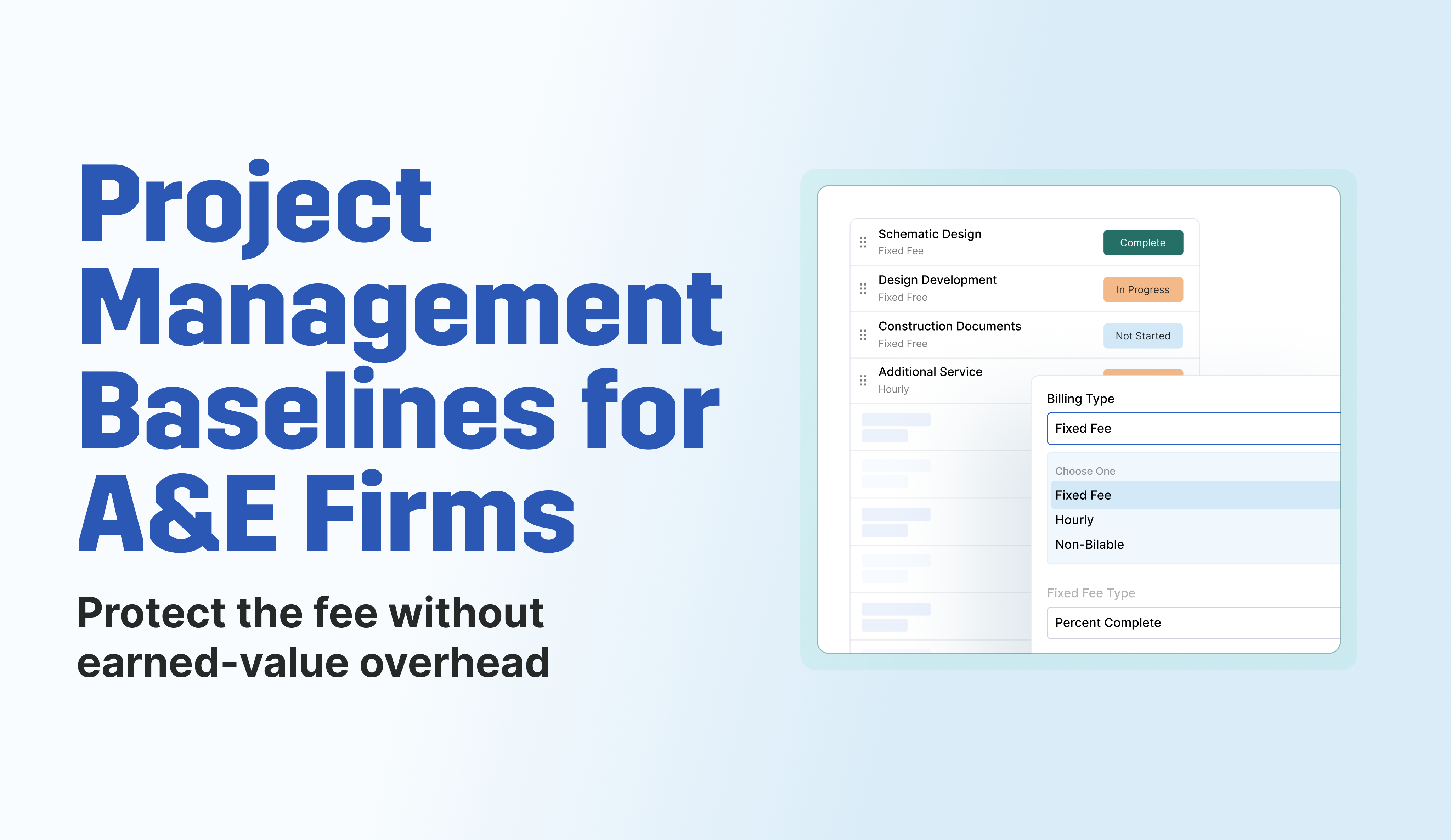


Project managers need to know whether the work left in a phase will fit within its remaining fee, and that becomes harder to judge near the end of the phase.
A phase may sit at 90% complete while the team continues responding to client comments, coordinating consultants, and completing final reviews. If the project manager has underestimated the effort, the phase will run out of hours before the work ends.
A project baseline provides the reference needed to catch that gap. It preserves the original scope, schedule, fee, planned hours, and subconsultant allowances so the project manager can compare the plan with the work underway. Factor’s 2026 benchmark found that 56% of A&E firms report budget overruns on more than one in ten projects.
This guide explains how to set a baseline for fees and phases, review it during delivery, and decide when to hold the original plan or formally reset it.
What is a Project Baseline?
A project baseline is the approved version of a project's scope, schedule, and cost plan that serves as the fixed reference for measuring actual performance.
In an A&E firm, it records the deliverables and exclusions for each phase, milestone dates, fee, planned hours, labor mix, and subconsultant allowances.
On a fixed-fee project, the client fee remains fixed while the cost of delivering the work can change. The baseline indicates when additional hours, staffing changes, subconsultant costs, or added scope begin to reduce the margin built into that fee.
Why a Project Baseline isn't Just Your Schedule
The schedule covers only the timing of that commitment. It shows when the team expects to reach each milestone, but it cannot show whether the firm can still meet those dates within the fee.
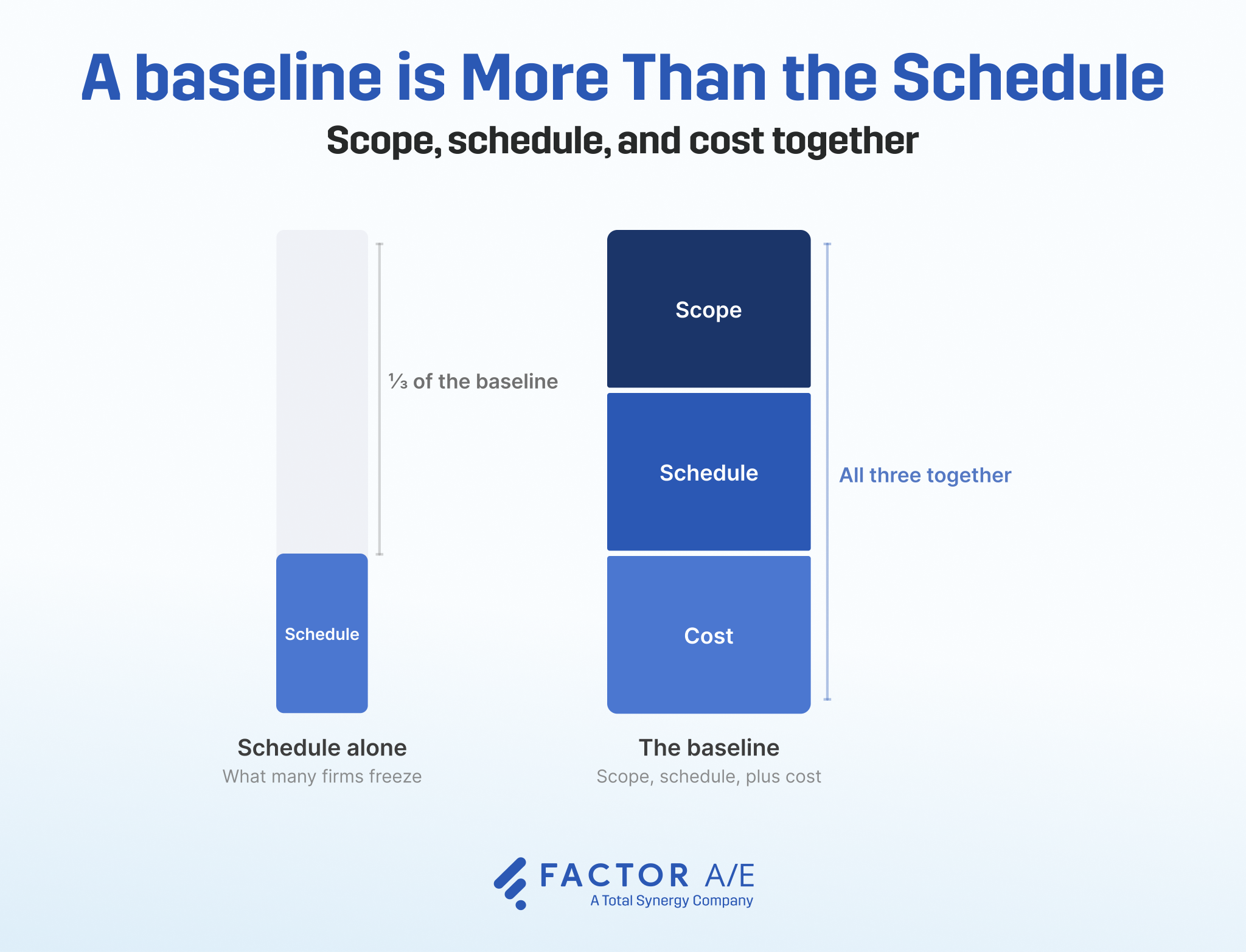
A team may meet every submission deadline only because senior staff step in, or because the project takes more hours than planned. The schedule remains on track while the phase loses margin.
Project baseline vs. current plan and forecast
The baseline also serves a different purpose from the current plan and forecast. The current plan shows how the team intends to complete the remaining work. The forecast indicates where the phase is likely to finish, based on its performance so far.
Keeping those views separate becomes difficult when the phase budget lives in a spreadsheet, the team records time somewhere else, and finance tracks consultant costs in QuickBooks. Factor’s Budget Setup keeps the fee, planned hours, labor mix, and subconsultant expenses organized by phase.
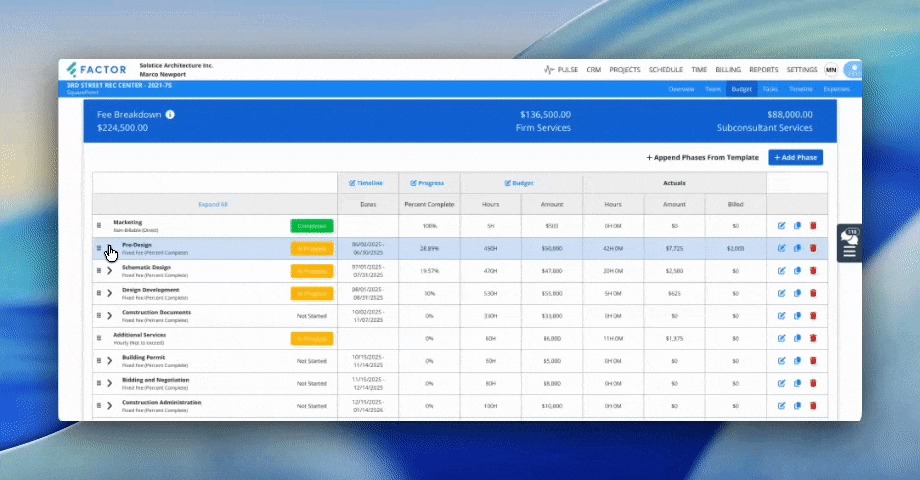
The project manager can then compare the original plan with the work underway without rebuilding the project from several systems.
A goal describes the result the firm wants, such as an on-time delivery or a healthy margin. The baseline provides the numbers the project manager uses to judge whether the team can still achieve that result. That fixed reference turns the rest of the project management workflow into something the firm can check while it still has time to respond.
The Three Project Baselines: Scope, Schedule, and Cost
A project baseline combines three component baselines: scope, schedule, and cost. The performance measurement baseline is not a fourth component.
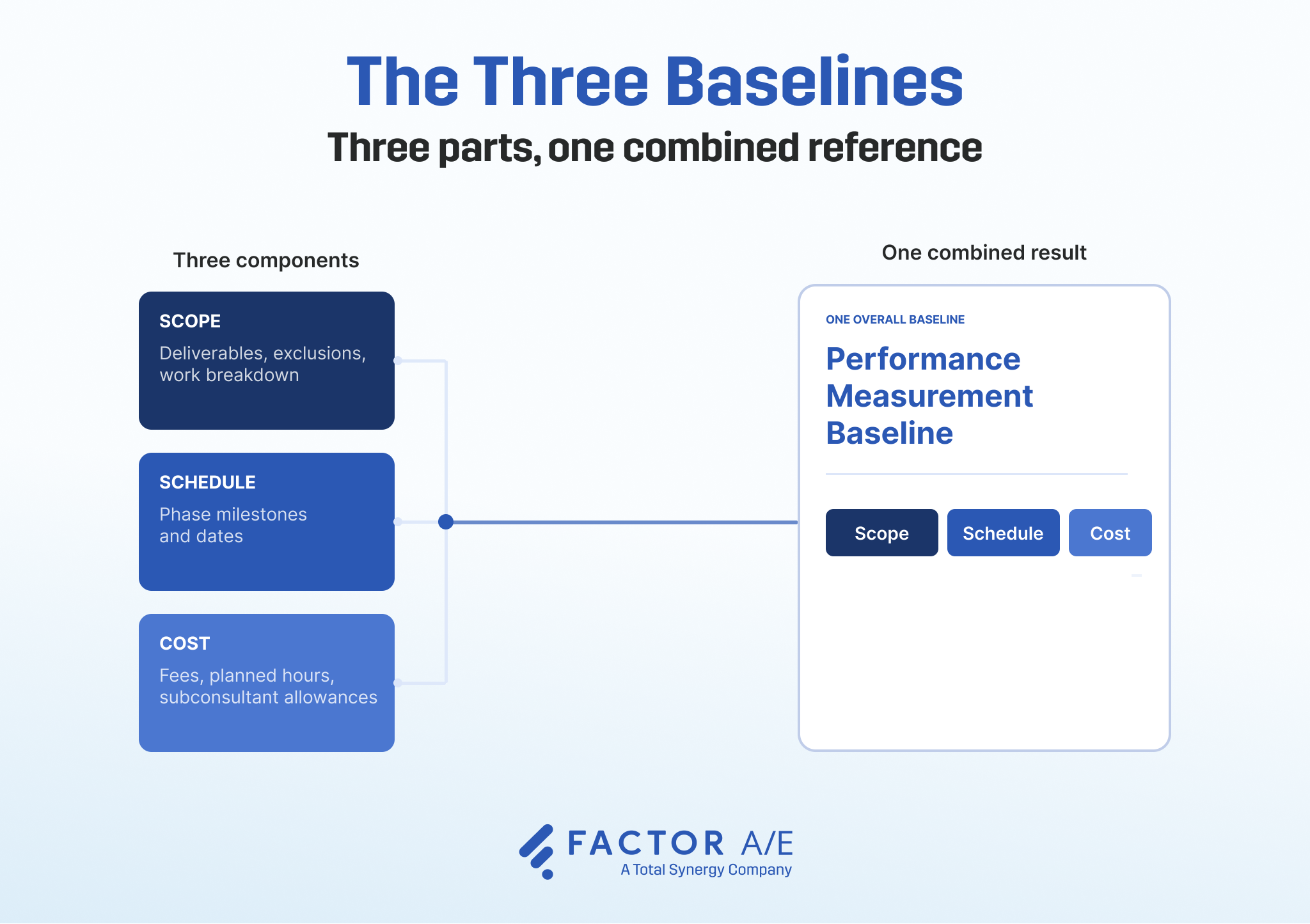
NASA defines the performance measurement baseline as the time-phased budget for completing the project’s authorized scope. Teams use it to measure performance through earned value management or another performance measurement method.
For an A&E firm, each baseline answers a different project-control question.
Scope baseline: What did the firm agree to deliver?
The scope baseline records the services, deliverables, assumptions, and exclusions for each phase. It gives the project manager a boundary to check when a client adds another option, requests another revision, or changes an earlier decision.
Without that boundary, the team may continue working without deciding whether the agreement covers the additional effort. The hours then appear to be a budget problem, even when the project has actually developed a scope problem.
Schedule baseline: When should the work happen?
The schedule baseline records the approved phase milestones, submission dates, review periods, consultant inputs, client decisions, and approvals. These dependencies matter because the team does not control every date.
A delayed client decision may leave the final submission date unchanged and compress the work into fewer weeks. The team may still meet the milestone, but only by adding senior staff, overlapping work, or using more hours than planned. The schedule baseline helps the project manager trace that pressure back to the event that caused it.
Cost baseline: What should it take to deliver?
The cost baseline records the resources the firm expects to use for each phase. For an A&E project, that includes planned hours by role, labor cost, subconsultant commitments, and contingency.
The contract fee and the cost baseline are related, but they are not the same number. The fee sets what the firm can earn for a fixed scope. The cost baseline shows what the firm expects to spend on delivering it. Project margin depends on the difference.
The three baselines work together. A scope change affects the work required. That work affects the schedule, staffing, and cost. Holding all three gives the project manager enough context to identify what changed and how it threatens the fee.
How to Set a Project Baseline in Fees and Phases
To set a project baseline, define the scope, schedule, and delivery cost for each phase. Once you've done that, confirm that the team can deliver the plan and save the approved version before work begins.
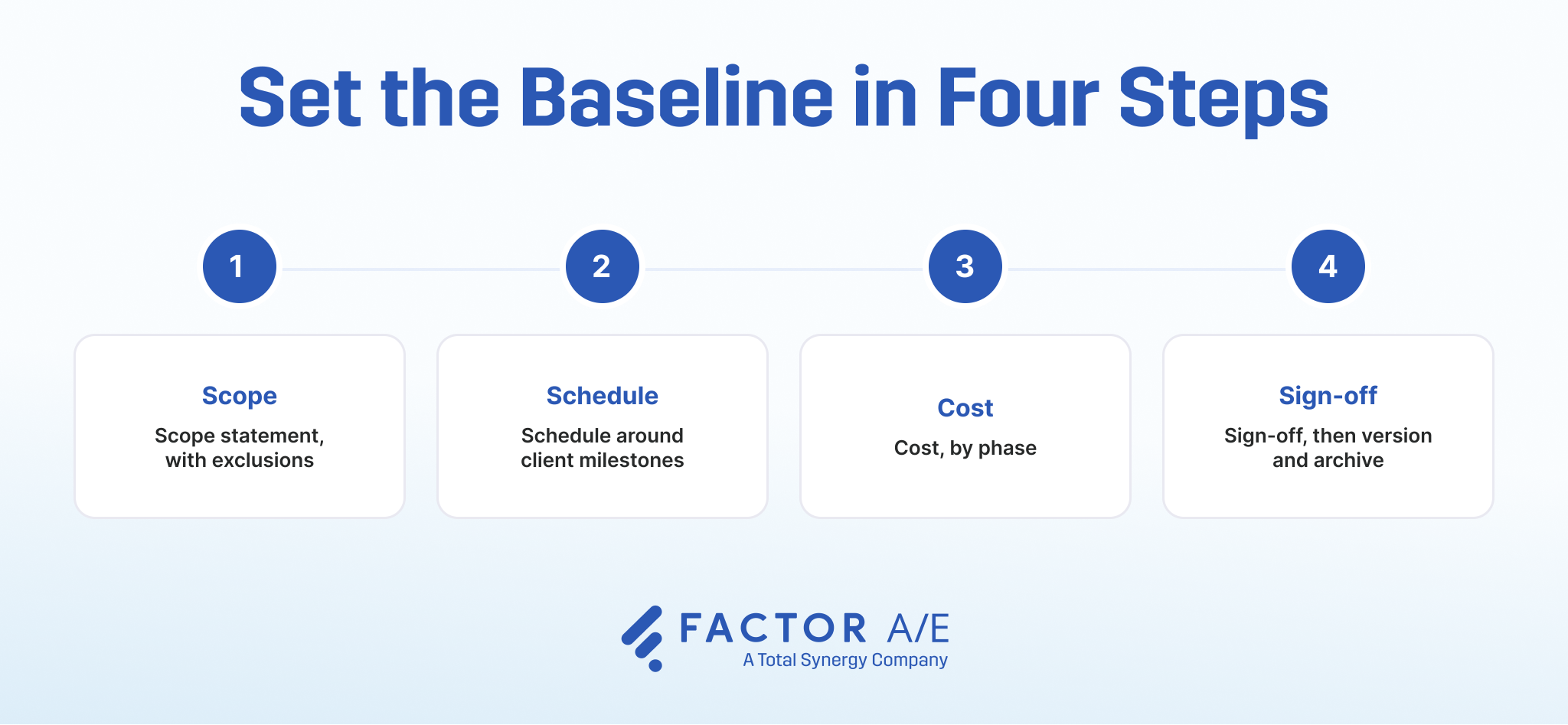
The baseline should use the same phases, hours, roles, fees, and subconsultant commitments that the project manager will track during delivery.
- Define the scope of each phase: Record the services, deliverables, assumptions, and exclusions included in the agreement. The record will include details that affect effort, such as the expected number of review rounds or the information the client must provide. These boundaries help the project manager determine whether a later request falls within the original scope.
- Set the phase milestones and dependencies: Work backward from each submission date, allowing enough time for consultant coordination, client review, and approvals. Be clear about which dates your team owns and which rely on someone else. If a client review runs late, the baseline should show how that delay affects the work ahead, rather than making the team look as though it simply missed the plan.
- Build the delivery plan for each phase: Allocate the fee, then estimate the hours and labor mix required to deliver the work. Add planned labor cost and committed subconsultant costs separately. The AIA recommends breaking the project into phases and tasks and budgeting for each. This level of detail helps the project manager see whether the planned work fits within the fee before approving the baseline.
- Show contingency separately: Record it as a visible allowance rather than spreading extra hours across tasks. This lets the project manager see when the team starts using it and what event requires it. The allowance should reflect the project's uncertainty, including unresolved scope, coordination risk, or approval requirements, rather than serve as a hidden fee available for routine work.
- Test the plan, approve it, and save the version: Ask the project manager and discipline leads to confirm that the planned team can complete the scope within the assigned hours and dates. Once the principal approves the plan, save and date it as the baseline of record. Keep later forecasts separate so the firm can see how the expected outcome moves away from the original plan.
The result is an agreed-upon reference that links the contract to the team's expected approach to delivery.
When a request, delay, or staffing change occurs, the project manager can compare it with the assumptions in the baseline and decide whether to adjust the current plan, update the forecast, or address a formal change to the project.
How Often Should You Check a Project Against its Baseline?
Review active project phases at least once a week. Monthly reporting may tell leadership where a project stands, but it arrives too late for day-to-day project control.
In 30 days, the team can spend four weeks of labor, complete a submission, respond to client comments, and commit additional subconsultant costs. Once the team has done the work, the project manager cannot recover those hours.
The review cadence should also follow the pace of the work. A phase with several people working toward an approaching submission needs a weekly check.
A project waiting on a client's decision or approval may need less frequent review, although the project manager should still track the delay and its effect on the remaining schedule.
Formal earned value management uses cost accounts and performance indexes to measure completed work against the approved plan. Most growing A&E firms do not need that level of administration. They need a short review that answers four questions.
- Are the actuals current? Confirm that the team has submitted its time and that the project includes all known subconsultant commitments. Missing hours or late consultant costs can make a phase look healthier than it is. Correct the data before changing the delivery plan.
- How much work remains? Review the percent complete, but test the estimate behind it. Ask what the team still needs to produce, coordinate, review, revise, and submit. A phase marked 90% complete may require more than 10% of its planned hours to finish. The AIA recommends assessing progress by phase as the firm delivers its services, and the project manager must still estimate how much effort the remaining work will require.
- Does the remaining work fit within the remaining budget? Compare the hours and costs recorded to date with the hours, labor mix, and subconsultant allowances left in the baseline. Then estimate the people, hours, and consultant costs required to finish the phase. If the remaining work requires more resources than the phase has left, update the forecast to show the expected overrun. Waiting for the next invoice will only reduce the options available.
- What caused the gap? The numbers identify a variance, but they do not explain it. The project manager must determine whether the original estimate missed necessary work, the labor mix changed, the team performed internal rework, a client decision disrupted delivery, or the scope grew beyond the agreement. Each cause requires a different response: correct the data, change the remaining staffing plan, address a delivery problem, update the forecast, or discuss additional services with the client.
Factor’s earned value analysis supports this review at the phase level. It brings percent complete, logged hours, the phase budget, and committed consultant costs into the same view, so the project manager can see which phase needs attention before investigating the cause.
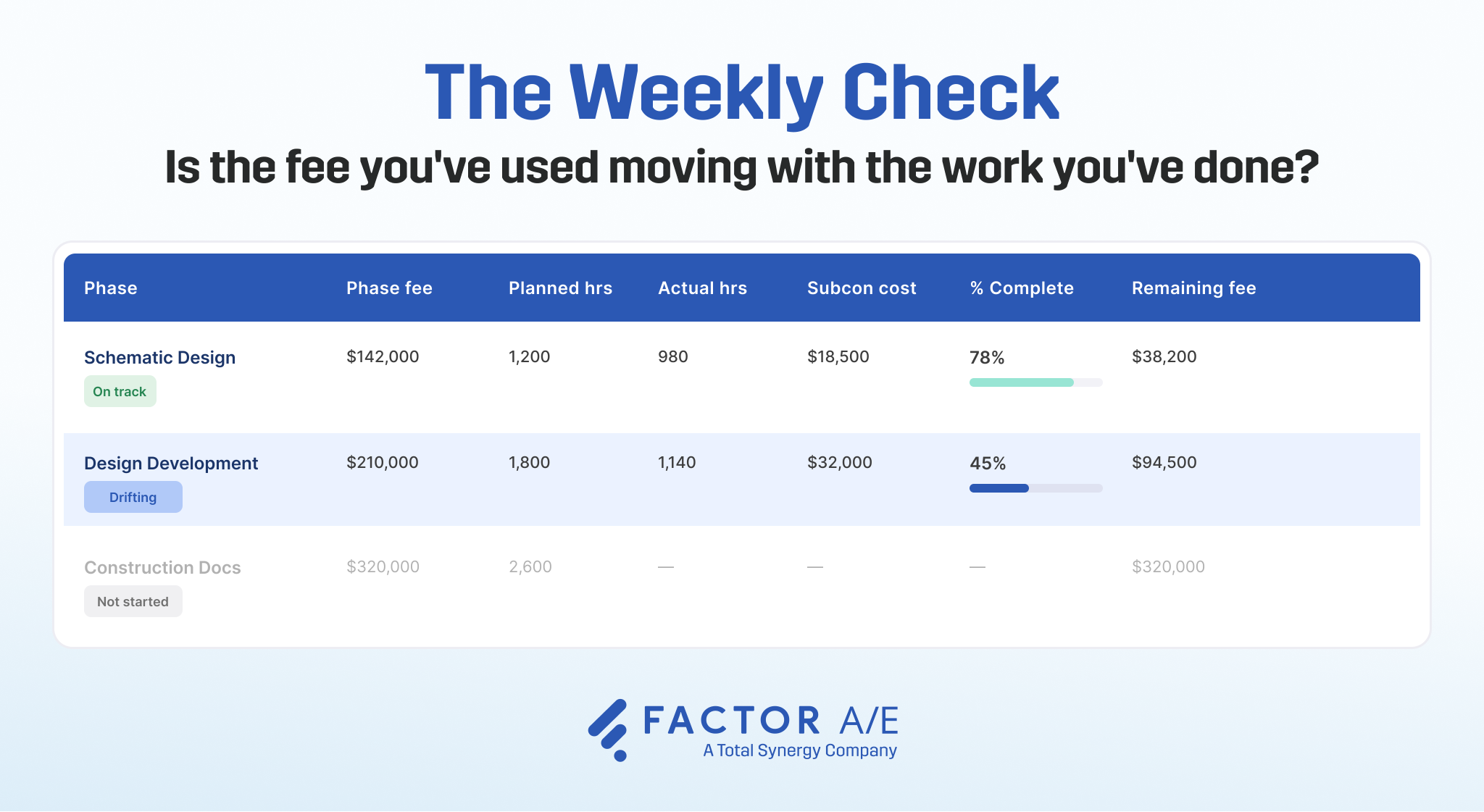
The review moves that decision forward while the team can still influence the outcome and keeps work-in-progress reporting aligned with the work underway.
When Should You Re-Baseline a Project?
The temptation to reset the baseline usually arises when a project starts to look worse than planned. A phase has used too many hours, a staffing assumption was wrong, or the team has had to redo work.
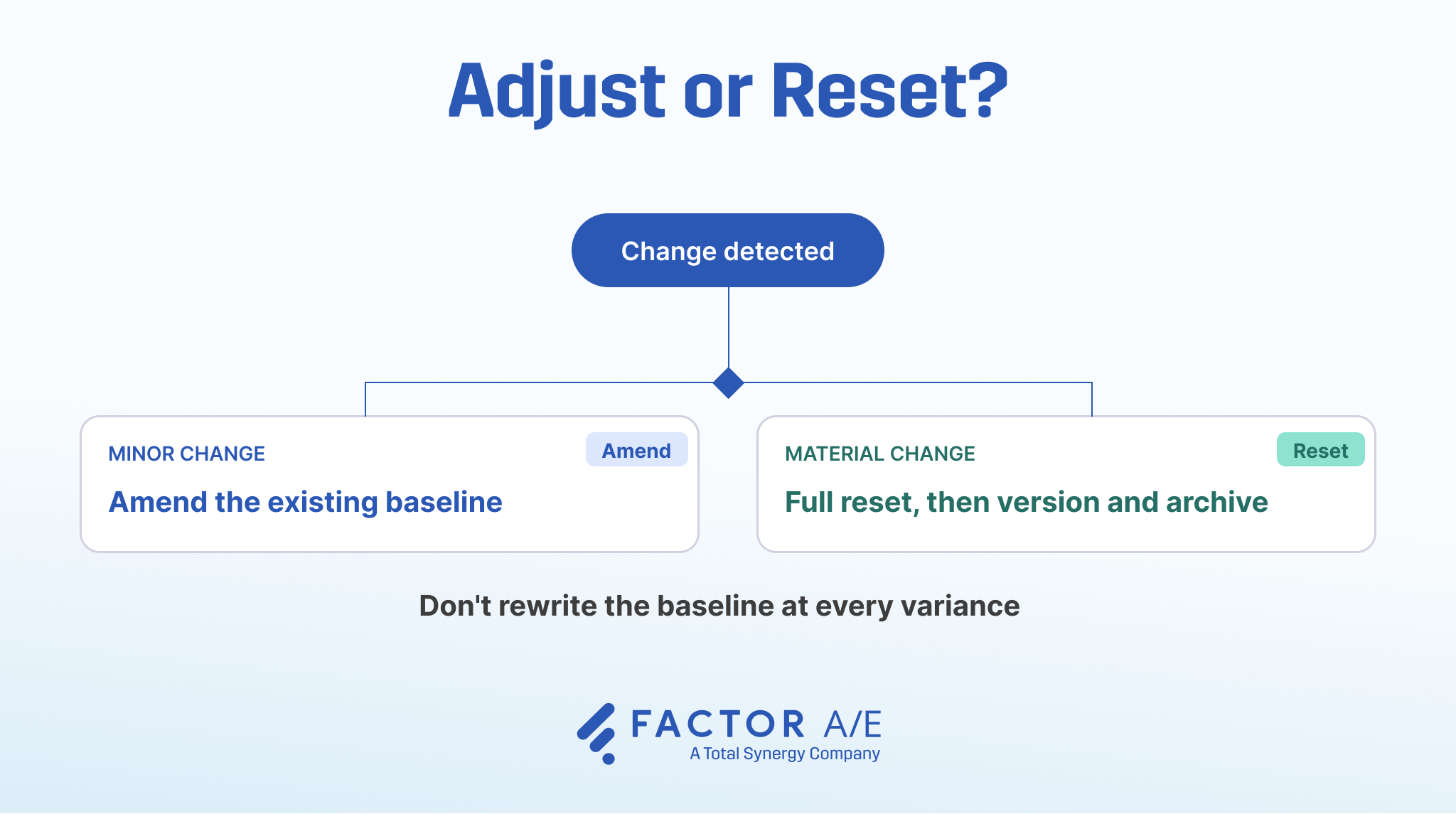
Moving the original numbers may clean up the report, but it also removes the evidence the project manager needs to understand what happened.
Save re-baselining for a material change that the firm and client have approved, such as an added scope, a revised fee, or a major shift in the delivery schedule. An overrun or an inaccurate estimate may affect when the project will finish, so update the forecast. Keep the original baseline in place so the team can still see the variance and learn from it.
Use the cause of the change to determine the right action:
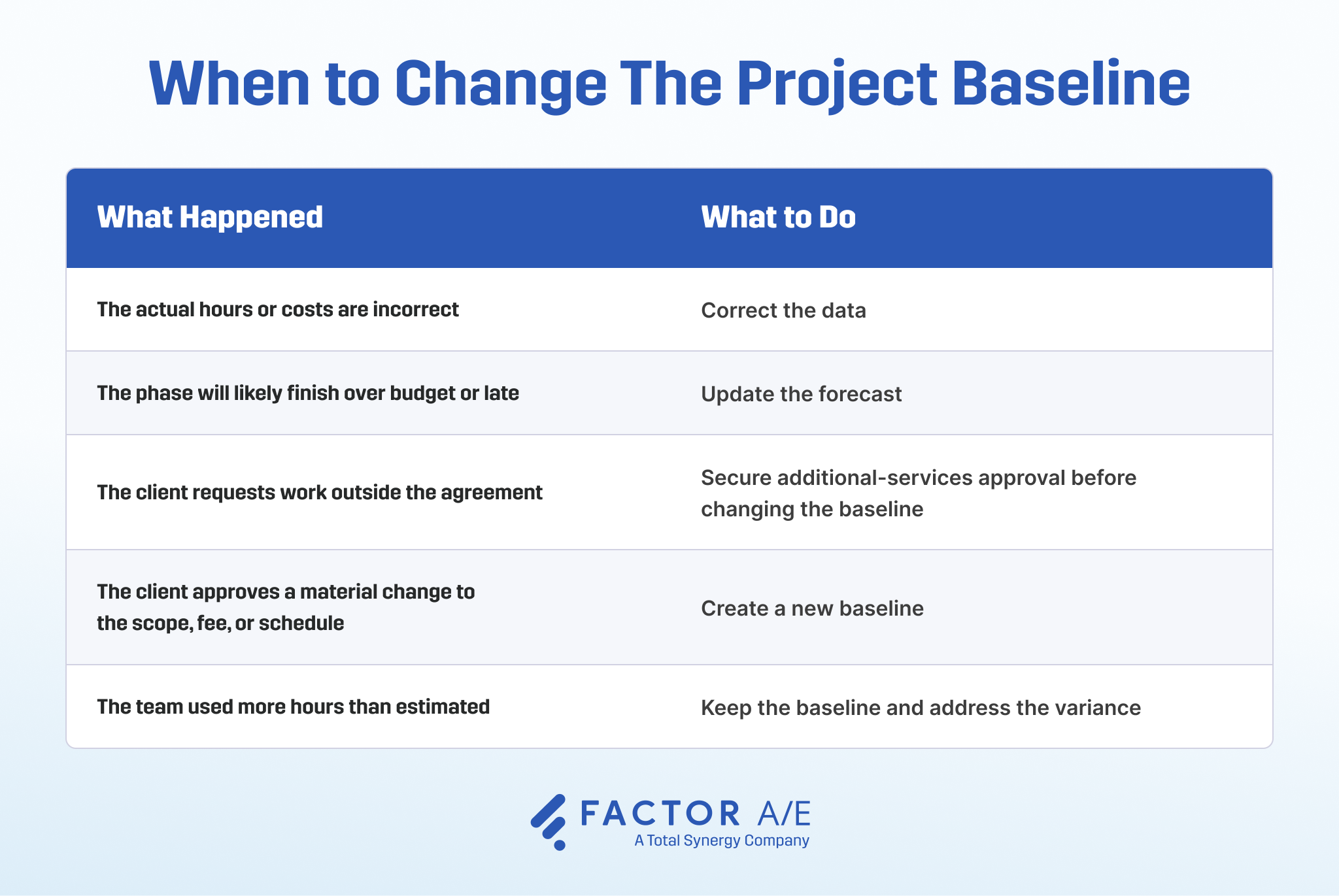
When the project requires a new baseline, save it as a new version and retain the original. Record what changed, why it changed, who approved it, and how the change affects the fee, hours, milestones, and subconsultant commitments.
The Department of Energy's reserve guidance makes a useful distinction: firms should not use reserves to mask poor performance or fund work that no one approved. The same principle applies here. Reforecast when the expected outcome changes. Re-baseline when the approved project changes.
Protect the Fee Before the Invoice Confirms the Overrun
A baseline gives the project manager time to act between the first sign of drift and the point when the firm must absorb the cost. That time matters. Once the team has done the work, the firm cannot recover the hours by changing the plan after the fact.
Factor carries the phase structure created during Budget Setup into the weekly review. As the team records time and updates the percent complete, the project manager can compare current performance against the planned fee, hours, and subconsultant costs for that phase.
Its two-way QuickBooks Online sync updates project and accounting data in real time, so project managers and finance teams work from the same numbers with no double-entry.
The software can surface the variance, but the project manager still has to estimate the remaining work, diagnose the cause, and decide how to respond. For projects already underway, document the actual position today and establish a control point for the work ahead. Keep the original contract and prior performance visible rather than treating today's plan as though it existed at kickoff.
Start with the 2026 A&E Industry Benchmark Report to compare your firm's approach with the industry. To see how Factor supports phase-level baseline tracking, book a demo.

Recommended articles
.png)

See Factor in action
In one quick call, we’ll show you a simpler way to run projects and get paid faster.
.png)
“I recommend Factor to other firms. The team is great, it’s easy to use, and it has streamlined my project management. It can do the same for yours.”
Adam Mayberry
Architect / Managing Principal


