2026 Architecture & Engineering Industry Benchmark Report
What's really happening inside A&E firms right now? We went straight to the source.
We surveyed architecture and engineering firms to get an honest picture of how the industry is actually operating. Where firms are thriving, where they're stretched thin, and what the road ahead looks like.
The findings are candid, sometimes surprising, and packed with data you can actually use. Whether you're looking for a benchmark, a blind spot, or proof that the rest of the industry is dealing with the same things you are, it's in here.
Happy reading!
Want a sneak peek? Here are some of the highlights from the report.
Firm Profiles
The firms we heard from differ in size, structure, and location, but the pressures are shared.
Most are small and mid-size practices navigating full workloads, lean teams, and the constant tension between delivering great work and running a tight operation.
As workloads grow and complexity increases, visibility and control are what separate firms that deliver consistently from those that are always catching up.
- 57% of respondents are architecture firms; 38% are engineering firms.
- 49% of firms have 10 or fewer employees.
- 54% operate on a hybrid model, making distributed workforce management a permanent part of running an A&E firm.
- The average project fee reported is $218,000, with a wide range from under $50k to $1M+.
Operational Efficiency & Workflow
Nearly half of firms are holding onto meaningful design time, but the pressure is real.
Project management tasks top the list of what pulls teams away from billable work, followed closely by client communication and approvals. For smaller firms where principals wear multiple hats, this creates a compounding problem. Every hour spent on coordination is an hour not going toward the work clients are actually paying for.
Firms protecting their design time with the right systems are building practices that are sustainable, not just busy.
- 44% of firms say project management tasks are the #1 thing pulling their teams away from design.
- 38% say client communication and approvals are the second biggest time drain.
- 58% of firms report utilization rates of 71% or higher, a healthy signal.
Project & Resource Management
Firms know that tracking profitability matters. But understanding it and doing it in real time are two different things.
40% of respondents do not track project profitability in real time, which means that by the time a problem becomes visible, there is often little room to course correct. Firms that do track it in real time are in a much stronger position to catch scope drift early and protect their margins.
The top reasons budgets go off track are scope creep, underquoting the initial project fee, and poor project tracking. All three are interconnected, and all three are manageable with the right systems in place.
- 73% of firms name scope creep as the #1 budget killer, yet 40% don't track profitability in real time.
- 7 in 10 firms manage resources manually through meetings, spreadsheets, or no formal process at all.
- 50% match staff to projects based on gut feel alone.
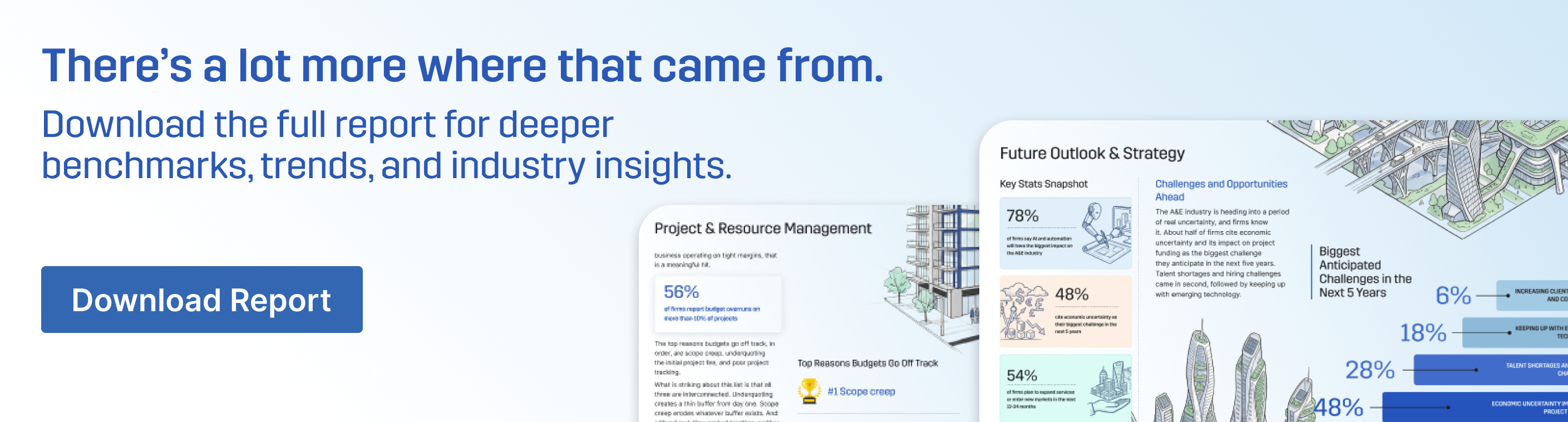
- 56% of firms report budget overruns on more than 10% of projects.
Financial Performance & Metrics
For the firms that track their net profit margins, the results are encouraging. But the more striking finding is how many firms simply don't know their numbers.
42% of respondents could not report their own profit margin. That makes it very difficult to make informed decisions about pricing, staffing, or growth. Profit margin is not just a financial metric. It tells you whether your fees are right, whether your projects are being managed efficiently, and whether the business is moving in a healthy direction.
- 1 in 3 firms that track their profit margins report net margins above 11%.
- 42% do not track their profit margin or are unsure of their number.
- 70% of firms wait 31+ days to collect client payments after invoicing.
- 60% of firms do not track their realization rate or are unsure of their number.
Human Resources & Talent Management
The number one personnel challenge across the industry is not finding people. It is having enough of the right people to keep up with the work.
40% of firms cite managing project demand with current staff levels as their biggest people challenge. Capacity challenges are often a systems and planning problem as much as a hiring problem. Firms with better visibility into their pipeline and workload are better positioned to anticipate when they will need more support and what kind.
- 40% of firms say managing project demand with current staff is their #1 people challenge.
- 47% report annual staff turnover under 5%, a healthy sign.
- 67% of firms allocate 3% or less of their budget to professional development.
- Only 8% have a formal mentorship or career development program in place.
- Only 16% of firms have a formal succession or leadership development plan.
Business Development & Client Relations
One of the most encouraging findings in this section is how strong repeat business is across the industry. 3 in 4 firms report that at least half of their clients are returning customers, a meaningful signal about the quality of work being delivered and the relationships firms are building.
But the data tells a more complicated story. Winning on reputation and relationship momentum is a real asset. Without a formal way to gather feedback, it is difficult to know what is working and what might be quietly costing future work.
- 3 in 4 firms say at least half their clients are repeat customers.
- 60% have no formal method to measure client satisfaction.
- The top three ways firms generate new business: referrals and word of mouth, networking and industry events, and partnerships and collaborations.
Future Outlook & Strategy
The A&E industry is heading into a period of real uncertainty, and firms know it. About half cite economic uncertainty and its impact on project funding as the biggest challenge they anticipate in the next five years. Talent shortages and keeping up with emerging technology round out the top concerns.
At the same time, a meaningful portion of firms are planning to grow. 54% plan to expand their services or enter new markets in the next 12-24 months.
- 78% of firms say AI and automation will have the biggest impact on the A&E industry.
- 48% cite economic uncertainty as their biggest challenge in the next 5 years.
- 28% say talent shortages and hiring challenges are their biggest anticipated hurdle.
- 54% plan to expand services or enter new markets in the next 12-24 months.