
Project Cost Estimation for A&E Firms: How to Build, Track, and Improve Your Numbers
Learn how A&E firms build accurate project cost estimates, track budget vs. actual by phase, and improve profitability over time.
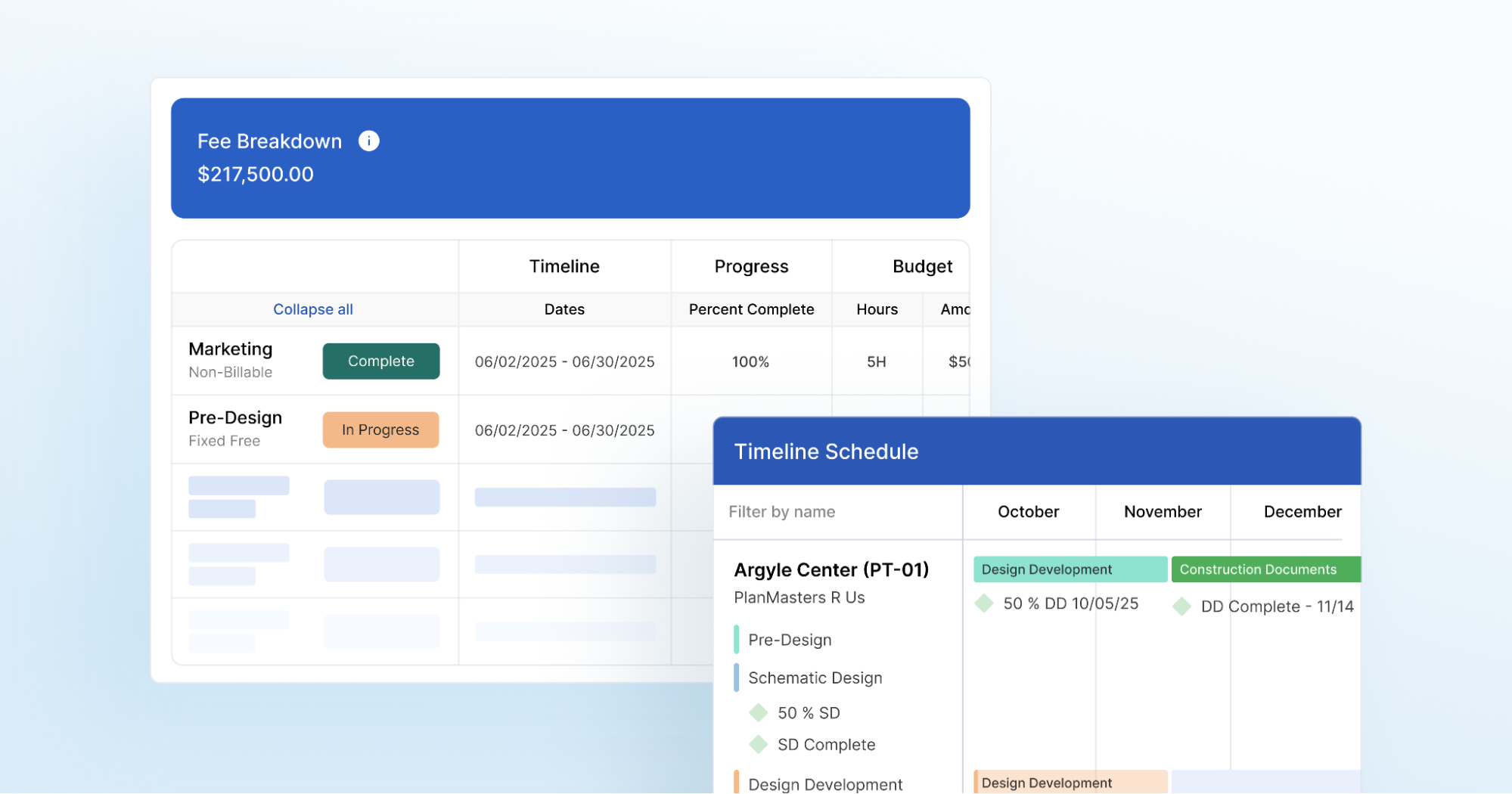


Project cost estimation doesn’t exist purely at the proposal stage.
The real challenge with project cost estimation isn’t producing the estimate itself, but maintaining accuracy once delivery begins.
A project that looked highly profitable upfront can quickly lose money if construction documents take longer to produce than expected or consultant coordination becomes a much heavier lift than budgeted.
This article explains how leading A&E firms use project cost estimates as an ongoing financial management tool, not just a proposal-stage calculation. We’ll cover the most common estimating methods, where estimates commonly break down, and how firms use operational data to improve profitability over time.

What is a Project Cost Estimate for an A&E Firm?
A project cost estimate is the firm's calculation of the cost to deliver a defined scope of work.
It's built primarily from the hours each team member will spend across each project phase, multiplied by their billing rate. Then, subconsultant fees, overhead, and reimbursable expenses are layered in to give a full picture of cost.
A project cost estimate is not the same as a construction cost estimate, though the terms sound similar.
A construction cost estimate prices materials, labor, and equipment for building a physical structure. A project cost estimate prices professional time and expertise, providing a forecast of how much of its people's time the project will consume and what that time costs.
What Goes Into a Project Cost Estimate for A&E Firms
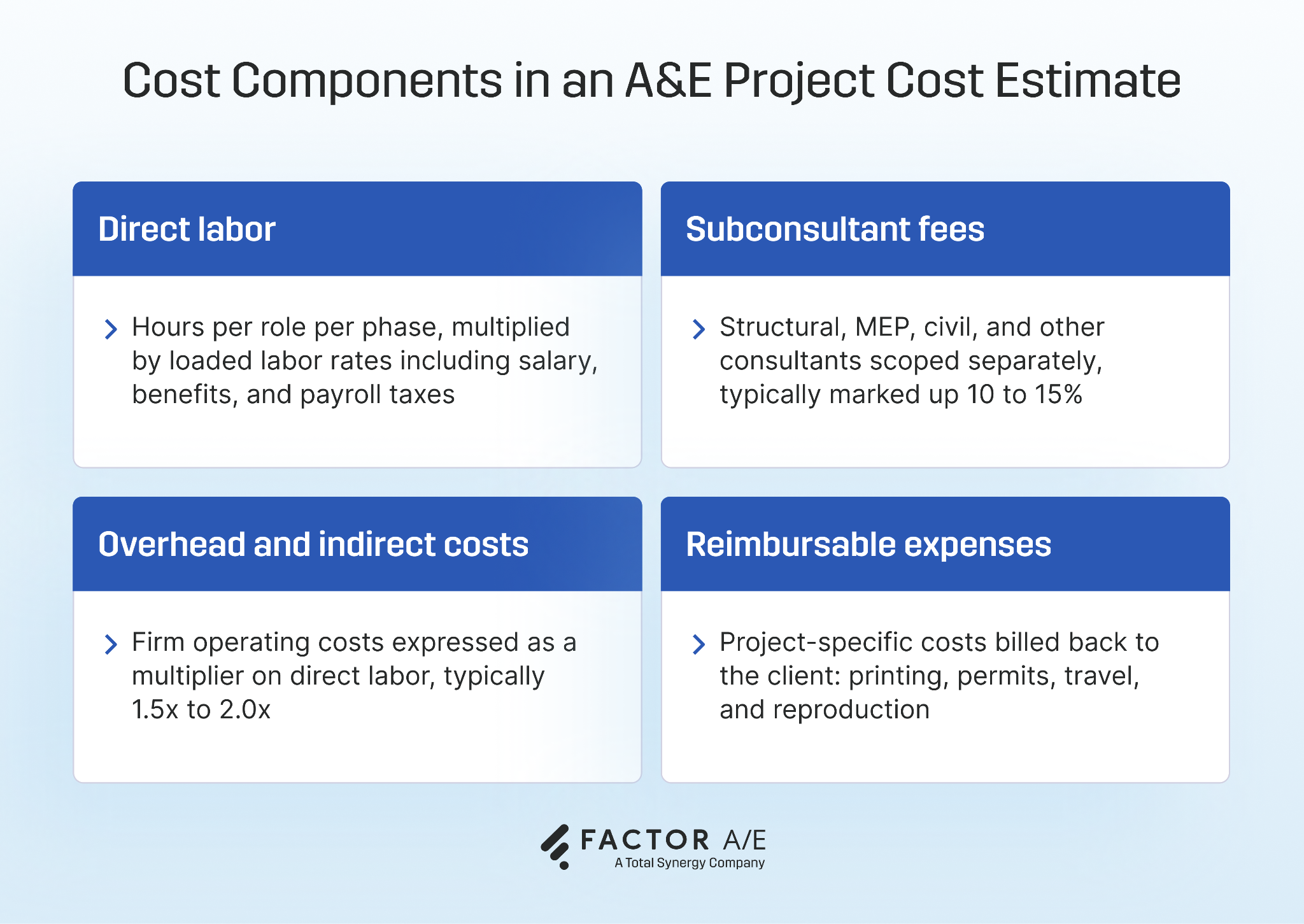
A complete project cost estimate accounts for four core components, each of which needs to be scoped and calculated before the firm has an accurate picture of what delivery will actually cost.
Direct labor
Direct labor is the largest cost component in almost every A&E estimate.
It is calculated by estimating the number of hours per role per phase. The firm must calculate the number of hours each of the principal, project manager, job captain, and intern will spend in SD, DD, CD, and CA.
Each role carries its own loaded labor rate, which is not just salary but salary plus benefits, payroll taxes, and other employment costs, representing the full actual cost to the firm of that person’s time.
This can be one of the more time-consuming aspects of project cost estimating, primarily because some firms still manage loaded labor rates in spreadsheets, which can go stale between updates or vary depending on who prepared the estimate.
Tools like Factor give A&E firms a single place to build and store project budgets across all of these components, labor, subconsultants, overhead, and reimbursables, so estimates are consistent from project to project and accessible to the whole team from day one.
Subconsultant fees
Structural, MEP, civil, geotechnical, and other subconsultants are scoped and priced separately and incorporated into the overall project estimate.
A&E firms typically apply a markup to subconsultant fees (10-15%) to cover coordination time and administrative costs.
Overhead and indirect costs
Overhead covers the costs of running the firm that are not tied to a specific project, such as rent, insurance, project management software, and administrative staff.
This is expressed as a multiplier applied to direct labor. The industry range for this multiplier is typically 1.5x to 2.0x, with many mid-size firms closer to 1.75x. For example, a firm with an overhead rate of 1.5x is spending $1.50 in overhead and indirect costs for every $1.00 of direct labor, and this needs to be incorporated in the project cost estimate as well.
Reimbursable expenses
Reimbursable expenses are costs incurred on behalf of a project that are billed back to the client, such as:
- Printing
- Permit fees
- Travel
- Reproduction
Firms should clearly define what counts as a reimbursable expense in their contract, and track and document costs incurred throughout delivery. Any costs that aren’t reimbursed (either because they weren’t tracked or weren’t scoped up front) take a direct hit on the project’s profitability.
Project Cost Estimation Methods A&E Firms Use
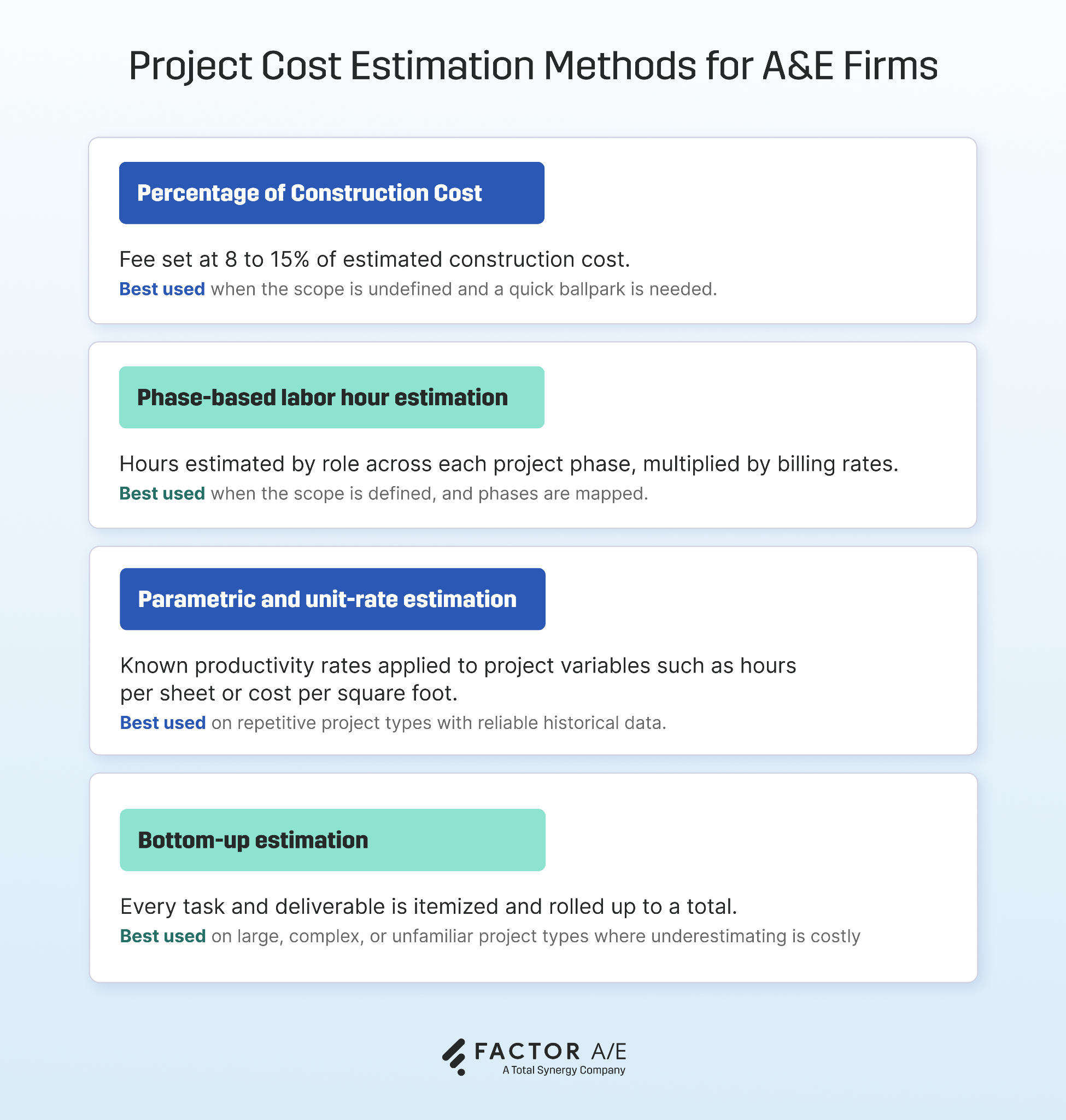
There are a few different methods you can use to estimate project cost, but experienced firms don’t typically rely on a single method.
Instead, the approach they choose depends on how much information is available at the time they build the estimate.
At the start of a conversation with a potential client, the scope might be loose and the program undefined, so a percentage of the construction cost gives a quick ballpark. Once the scope is clearer and the phases are defined, phase-based hour estimation becomes the primary method. On a complex or unfamiliar project type, a firm might layer in bottom-up estimation for the phases that carry the most risk.
Percentage of construction cost
When using the percentage of construction cost, firms set their fee as a percentage of the total estimated construction cost, typically ranging from 8% to 15%, depending on project complexity.
Say a firm needs to estimate the project cost for a medical office building with a construction cost estimate of $2.8M. There is no program, no defined scope, and the client just wants a ballpark fee to see if the project is viable. They quote 10% of the construction cost, giving a $280k fee estimate to anchor the conversation.
This is not the most detailed or accurate way to produce an estimate, and it breaks down on a project without clear construction costs (such as renovation work), or in any project where the scope is unusually service-heavy relative to the build cost. However, it's useful as a quick sanity check at early project stages before the scope is defined.
Phase-based labor hour estimation
Using phase-based labor-hour estimation, firms estimate hours by role for each project phase, then multiply those hours by role-based billing rates to arrive at a phase fee and a total project fee.
Let’s say that the medical office building project from above moves forward.
Now, the firm knows it's a two-story build, has a defined program, and can map out the phases. They estimate 120 hours of principal time, 340 hours of PM, 280 hours of job captain, and 180 hours of drafting across SD through CA, multiply each by loaded labor rates, and arrive at a more realistic and grounded phase-by-phase fee.
This is the most practical and reliable method, as it reflects how projects are actually structured and delivered. It also gets more accurate over time as you build up historical data on how many hours similar projects actually consume by phase.
Parametric and unit-rate estimation
Parametric and unit-rate estimation uses known productivity rates to build estimates quickly. Common units include:
- Hours per sheet
- Dollars per square foot of building area
- Hours per submittal review
For instance, a firm that does a lot of tenant improvements knows from historical data that CD production runs about 14 hours per sheet for their office. A new TI project requires an estimated 22 sheets, so they know it's going ot take about 308 hours of CD time.
This estimating method works well for repetitive project types where the firm has reliable historical rates, but it's not a good fit for complex, custom, or first-time project types where there is no reliable baseline to draw from.
Bottom-up estimation
When using the bottom-up estimation method, firms itemize every single task and deliverable, estimate the time required for each, and add them up into a total project cost estimate.
For example, if a firm is asked to price a complex hospital addition that they've never done before, they might use bottom-up estimation. They’d itemize every deliverable: each drawing, each consultant coordination meeting, each review cycle, and each submittal response, then assign hours to each line item and total.
The trade-off on this method is clear-cut. It's the most accurate, but it's also the most time-intensive to produce. It's worth the effort on large, high-risk, and unfamiliar project types, where the risk involved in an inaccurate estimate is higher.
Where Project Cost Estimates Commonly Break Down
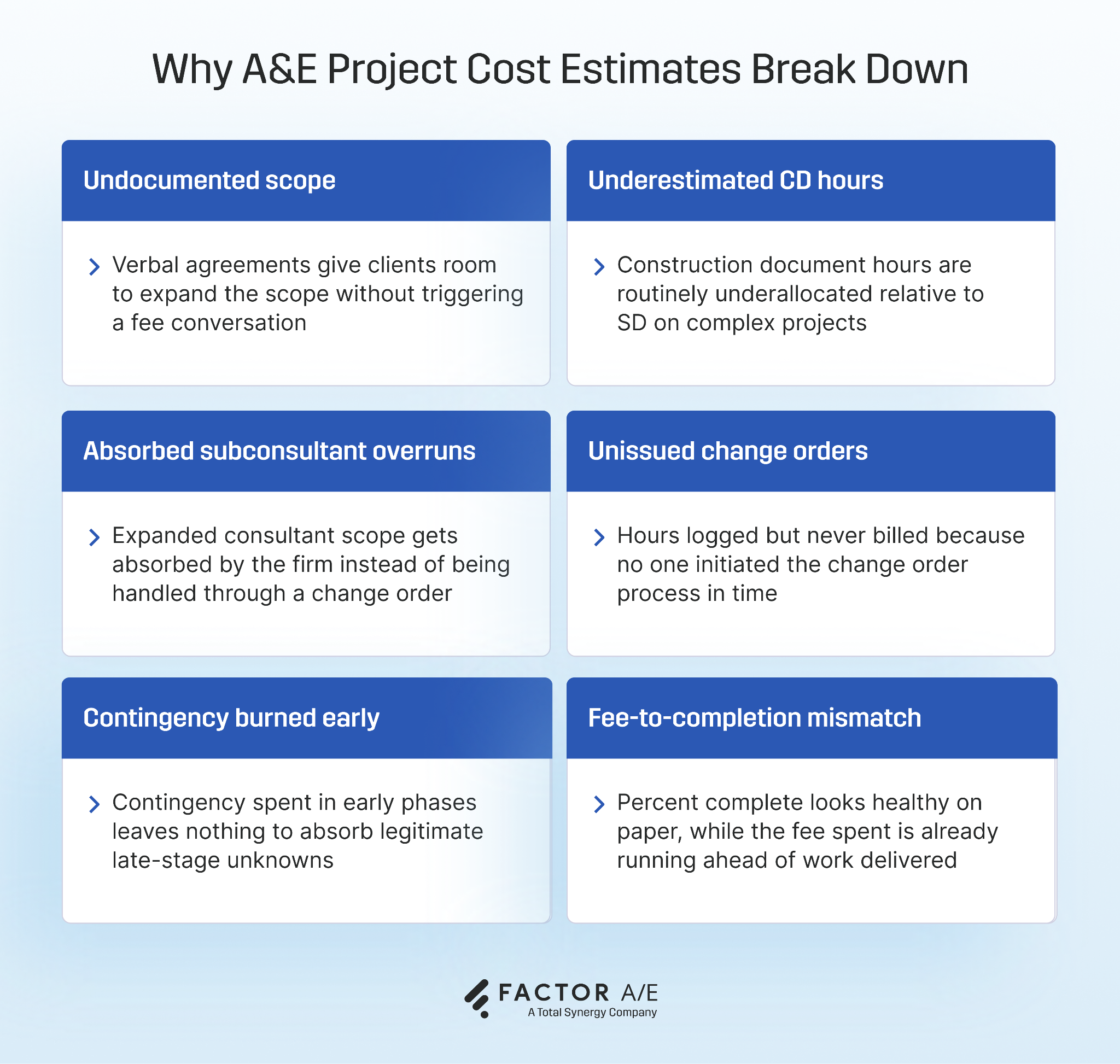
Projects often look profitable when the estimate is built, but still end up losing money by the end of the project.
Understanding where things typically go wrong helps you spot where the project is veering away from the cost estimate and course-correct while there’s still time.
These are the common failure points:
- Scope was verbally agreed upon but never formally documented, giving the client room to expand it without triggering a fee conversation
- Hour allocations per phase did not reflect actual complexity. CD hours are almost always underestimated relative to SD on complex projects
- Subconsultant scope expanded mid-project, and the firm absorbed the difference rather than issuing a change order
- Hours were logged against the project, but never billed because no one issued the change order in time
- Contingency was spent in early phases, and there was nothing left to absorb legitimate late-stage unknowns
- Percent complete looks healthy on paper, but the spent is already tracking ahead of the work delivered
Many of these failure points share a common root cause.
When project budgets, time entries, subconsultant costs, and change order status live in separate tools or spreadsheets, no one has a clear picture of where a project stands until it is too late to act.
Factor centralizes that data so project managers can see burn by phase, flag overspend early, and make informed decisions before a phase closes. It’s all about tracking actual performance against the estimate as the project progresses, so PMs can spot a failure point like spend tracking ahead of percent complete, and adjust early on.
Tracking Estimates Against Actual Performance by Phase
Building an accurate estimate is only half the job. The other half is tracking how the project performs against it once delivery begins.
Track at the phase level, not just the project level
Project-level tracking tells you you're over budget. Phase-level tracking tells you which phase went over and when, giving the PM time to act.
To track spend at the phase level, set up your project budget with a fee allocation for each phase before work starts. Then, review burn by phase on a regular cadence, weekly or biweekly, depending on project pace.
Make time tracking non-negotiable across the team
Without accurate data on hours spent, the estimate lacks a feedback loop, and every future project is priced on the same incomplete information.
Establish phase codes for every project before work starts, and ensure the entire team knows what to log against each phase. Review time tracking entries regularly, not just at month-end, to catch miscoding or gaps early.
Factor makes this process significantly easier by keeping project budgets, logged hours, and phase burn data in one place.
Measure burn rate against percent complete, not dollars spent
At each phase check-in, the PM should compare the fee spent with an honest estimate of how much of that phase's work is actually done, not just the total budget for that phase.
If the fee spent is tracking ahead of the percent complete, that’s a warning sign for project profitability. Flag it immediately, identify what is driving it, and decide how to respond before the phase keeps moving (and spending).
Make an active decision when a phase starts tracking over
If a phase is tracking over the estimate, you have three main options:
- Adjust scope
- Issue a change order
- Consciously absorb it (and lose margin)
Document whichever decision gets made, and why, and add it to the agenda for your post-project review.
Building Better Estimates Over Time
Creating accurate project estimates isn’t just about choosing the right method for the job. It's about using the data that each completed project contains to make the next estimate more accurate.
After every project close-out, run a post-project financial review, comparing estimated hours by phase to actual hours logged. Where discrepancies are found, flag where subconsultant estimates were off, identify any write-offs, and note where contingency went and why.
Then, feed that data back into your phase assumptions for the next similar project type. For example, if CD hours ran 30% over on two consecutive projects of the same type, it's like a calibration problem. Next time you estimate a similar project, you’ll know to increase your CD hours.
Factor makes this a routine rather than a one-off exercise. Because project budgets, logged hours, subconsultant costs, and phase burn all live in one place, the post-project review becomes a report you run rather than a spreadsheet you rebuild from scratch.
Over time, you can build out rate templates directly from past project actuals, so each new estimate starts from a baseline that reflects how your firm's projects actually run, not how you expected them to run.
Building a More Profitable Practice, One Project at a Time
Project cost estimation only works as a financial management tool when the data behind it is current and accessible throughout delivery.
With Factor, estimates, logged hours, subconsultant costs, and phase burn all live in one place. Project managers can track what is actually happening against what was planned and make decisions while there is still time to act on them.
Book a demo to see how A&E firms use Factor to build better estimates and protect margin from proposal through close-out.

Recommended articles


See Factor in action
In one quick call, we’ll show you a simpler way to run projects and get paid faster.
.png)
“I recommend Factor to other firms. The team is great, it’s easy to use, and it has streamlined my project management. It can do the same for yours.”
Adam Mayberry
Architect / Managing Principal


