
Architectural Planning in Architecture Firms: Phases and Financial Visibility
Understand the six phases of architectural planning and why many architectural firms struggle to see project financial performance while work is still in progress.



Most architecture firms manage projects through a familiar sequence of phases. Feasibility, schematic design, design development, construction documents, and construction administration. Each stage organizes decisions and produces the drawings contractors need to build.
On paper, the structure works.
But the phase structure tells you what work should be happening, not whether your project is actually performing during that work.
Your project can move smoothly from schematic design to design development, even though the fee is already half spent. Staffing adjustments lag behind schedule changes. Small-scope additions accumulate over weeks of coordination meetings. None of it is obvious in the phase plan itself.
In many firms, those signals only become visible when someone pulls the billing report or the financial summary, after the decision-making phase has already closed.
In this guide, we’ll help you understand how architectural projects move through their phases, which helps explain why that gap appears and what it takes to close it.
What is Architectural Planning?
Architectural planning is the structured process of turning a client brief into something that can actually be built.
It spans site research, design development, technical documentation, and cross-disciplinary coordination, and moves work from early concept to fully resolved construction drawings.
Inside architectural firms, “architectural planning” means two different things.
First: the design discipline, the spatial and technical work of determining what a building should be, its layout, performance, and relationship to its site, and how its systems fit together.
Second: the delivery framework, which is the structure firms use to sequence decisions, assign responsibilities, and track progress through defined phases, milestones, and review gates.
While both are valid, they’re solving different problems.
A principal who views architectural planning as a design discipline asks whether the building is right. A project manager, viewing it as a delivery framework, is asking whether the project is progressing correctly in terms of schedule, scope, and budget.
Those two questions rely on different information, and in most firms, they’re answered at different times. But architectural planning, as defined at the start, requires both. You’re shaping the building and structuring the path to its construction.
If those two lenses stay disconnected, the process breaks: you either get a well-designed building that can’t be delivered, or a well-managed project that delivers the wrong outcome.
The 6 Phases of Architectural Planning
These 6 phases produce information that the next one relies on, and decisions made early tend to shape what's possible later in terms of cost, feasibility, and risk.

Each phase also functions as a checkpoint. There's a point in each one where certain decisions settle in, and the rest of the work starts building on them. Compressing a phase doesn't eliminate the work it was meant to do. In practice, that work tends to surface later, often when it's more difficult and complex to address.
Pre-design
Pre-design establishes what the project is working with: site analysis, setback requirements, zoning allowances, utility access, and the client's budget.
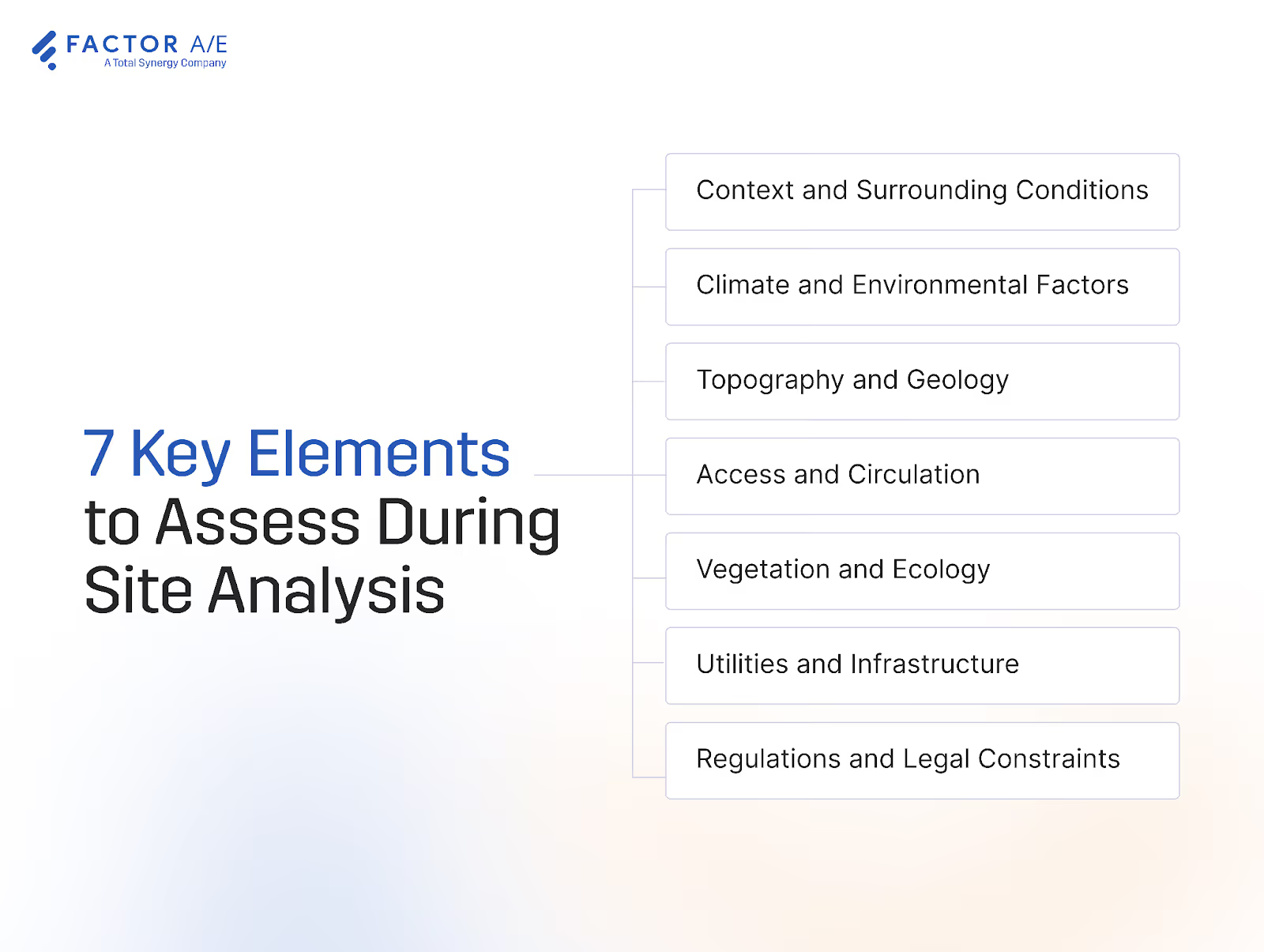
The firm collects the client brief, reviews the site, identifies what the zoning code and permitting process will allow, and sets initial budget parameters.
Together, these determine whether the project is feasible on the proposed site and within the client's stated budget.
This phase identifies the gap between what a client wants and what the site, zoning code, and budget can actually support.
Pre-design is when the client's stated program either fits within the site and budget constraints or is adjusted to do so.
Firms that move through pre-design quickly sometimes carry unresolved feasibility questions into schematic design. When those questions come up later, the design is too far along to restructure without revising drawings and restarting client approvals, and the fee spent on schematic work becomes sunk cost.
Schematic design
Schematic design translates the agreed-upon brief and site conditions into preliminary drawings: floor plans, elevations, and basic massing. The firm establishes the overall design direction and building layout, and the client receives the first visual representation of what the project will look like.

The focus at this stage is alignment, where your firm and the client need to reach a sufficient shared understanding for development to move forward on agreed terms. Specifically, this means the building's footprint, floor count, program layout, and primary circulation need to be agreed upon before the project moves forward.
Schematic drawings are not construction-ready, and resolving them to that level of detail at this stage would be premature.
This is also the phase where the program, layout, and design direction can still change without cascading into consultant drawings or permit submissions. The same changes in design development mean revising the structural and MEP coordination drawings already underway.
In schematic design, changes to the building layout are largely limited to the architect's own drawings and don't yet involve coordination with consultants.
Design development
Design development is where the design starts to solidify across all disciplines simultaneously. The firm coordinates materials, structural systems, and mechanical, electrical, and plumbing systems into a coordinated set of drawings that structural, mechanical, electrical, and plumbing consultants have all contributed to and signed off on.
The three decisions that most directly determine what the contractor will eventually price: structural system, envelope assembly, and mechanical approach, are confirmed here.
This phase carries more financial consequences than most firms formally track. By the end of design development, a quantity surveyor or cost consultant working from the drawings can produce an estimate within a reliable range.
The design is specific enough for that. The same was not true at the end of the schematic design phase.
Changes after design development mean revising drawings across multiple sheets, recoordinating consultant drawings, and potentially resubmitting to the permitting authority. The same decision made during design development is a single consultant call and a drawing revision.
Construction documents
Construction documents translate the developed design into the complete set of drawings and specifications needed for permitting and construction. This is the most technically intensive phase of the planning process, and the one that most directly determines how smoothly construction runs.

The completed document set specifies exactly what the contractor must build: dimensions, materials, systems, connections, and finishes.
It also resolves the coordination questions that design development left open, where structural beams intersect mechanical runs, where ceiling heights conflict with duct routing, and where specified materials don't match what the drawings show.
Ambiguity in the document set doesn't stay in the document set. It shows up during construction as RFIs, change orders, and back-and-forth between the contractor and the project team.
Firms that invest time in documentation quality during this phase tend to see fewer RFIs and change orders, as well as faster contractor response times.
Bidding and negotiation
Bidding and negotiation finalize project pricing and select the construction partner. Contractors price the work based on the construction document set, either through competitive bidding or direct negotiation, and the firm evaluates submissions before the client makes a final selection.
This phase tends to reflect how complete the scope definition is and how resolved the document set is. When both are in good shape, contractors can price the work with reasonable confidence and submit numbers that don't require significant qualification or revision upon client review.
When the scope has open questions or the document set has gaps, contractors respond with contingencies that can add 10-20% above what a complete document set would have avoided.
Significant bid-phase surprises, where pricing comes in materially above the client's budget, often trace back to unresolved scope or cost assumptions carried forward through design development, without running a cost estimate against the developed design before moving into construction documents.
Construction administration
During construction administration, the architect shifts from producing the design to comparing work in place against the approved drawings and specifications, reviewing submittals for compliance, and flagging deviations before they become permanent.
The firm conducts site visits, responds to RFIs, reviews shop drawings, and approves contractor payment applications based on work completed.
The contractor controls construction: means, methods, sequencing, and site safety. The architect tracks alignment between what the contractor is building and the documents, and resolves field questions as they arise.
When open issues carry over from the construction documents or earlier phases, they emerge here as weekly or biweekly RFI batches, pulling the project architect away from other work and pushing the contractor's schedule.
Construction administration is where the quality of documentation becomes visible in project performance.
Phase Compliance Doesn't Always Translate Into a Profitable Project
The six planning phases organize design decisions. They establish how the work is advancing, but not whether the fee budget is holding as it is. Teams can hit every milestone on schedule and still miss their margins, because fee burn isn't tied to phase progress in most firms.
Where phase progress and profitability start to drift
A project can move smoothly through each phase and still weaken financially. The issue is that phase progress and fee consumption do not always move at the same pace.
Milestones show what has been delivered. Project profitability shows what it costs to deliver it.
When those two signals are not visible together, project managers are left guessing whether the hours spent are still in line with the fee remaining to be earned.

A project might be 60% through design development, but have already used 80% of the fee for that phase. That leaves less room for revisions, coordination, and late-stage changes without cutting into the margin.
The risk is that the project appears on track while the economics are already slipping. In many firms, that financial signal sits in a separate system, so by the time teams see it clearly, the best chance to correct the burn rate has already passed.
Why does end-of-month invoicing often lag behind the work?
According to PSMJ's Financial Performance Benchmark Survey, only a minority of firms track earned value metrics that would reveal budget variance while delivery is still in progress. Most firms track hours consumed and fees spent.
Without earned value tracking, firms can't tell whether progress actually justifies the fee consumed. Those two numbers can look acceptable for a long stretch while still obscuring the more important question: whether the work completed has earned the fee already used.
There is often a lag of several weeks between when work happens and when its financial impact becomes visible.
The State of Professional Services report from Harvest found that professional services firms carry significant volumes of unbilled work at any given time, with collection cycles that further extend that gap.
For architectural firms operating on phase-based billing, the delay can span an entire phase milestone. When billing becomes the first real signal, the project is being read in arrears rather than managed in real time.
A project manager who discovers a fee overrun when the invoice gets prepared is usually working with a narrower set of options to adjust scope, staffing, or client conversations than they would have had mid-phase.
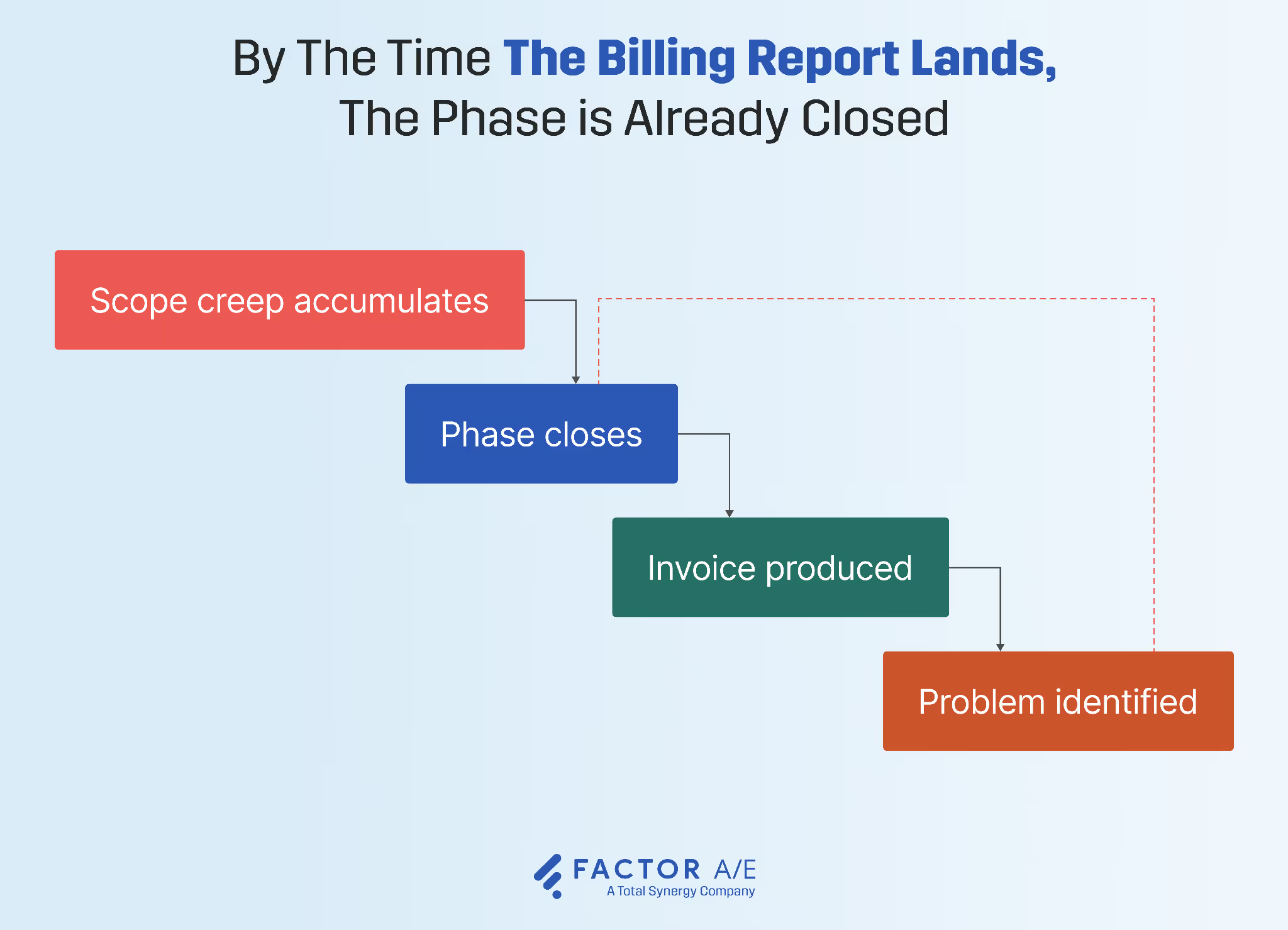
The phase where those decisions were available has already closed. That is why fee performance has to be visible during the phase, not after it.
How Architectural Firms Build Financial Checkpoints Into Each Phase
The phase plan tells you what work should happen and when. It doesn't tell you what it's costing to do that work relative to what's left in the fee. Firms that close that gap don't wait for billing to find out.
Step 1: Give each phase its own fee budget before work starts
Before a phase opens, the project manager breaks the total project fee into phase-level budgets and allocates hours by role. Senior architect hours, technical staff hours, and consultant coordination, each with a number tied to the scope of that phase.
Base these allocations on prior-phase data, contract scope, and role-specific billing rates rather than on rough percentages.
Without that baseline, there is nothing to check against mid-phase. The burn rate check in Step two only works if the plan exists before the spending starts. A phase budget set up front turns the weekly check from a general sense of how things are going into a meaningful number.
Step 2: Run the weekly burn rate check
Once a week, the project manager pulls planned hours against logged hours for the active phase. Hours spent divided by total budgeted hours for the phase gives the percentage consumed. That number is the starting point for the check.
Two thresholds guide the interpretation. If the phase has reached its midpoint and has already consumed more than 60% of its hour budget, recovery becomes unlikely without scope or staffing changes.
If the burn rate spikes more than 15% week over week, something has shifted inside the phase, and it needs a closer look. The goal of this check is early detection to catch cost drift before it compounds into a full-phase overrun.
Step 3: Read the burn rate against scope completion
The burn rate percentage is meaningful only when compared to the phase scope that has actually been completed. Scope completion should be estimated based on completed deliverables rather than hours spent, using phase milestones as the reference point rather than logged effort.
A phase that is 40% complete by scope but has consumed 62% of its hour budget is not on track. The fee is running ahead of the work it is supposed to be funding. Left unaddressed, that gap tends to compound.
What looks like a manageable miss at the midpoint becomes a full overrun by phase close, because the remaining scope still has to be delivered against a budget that is already mostly spent.
Step 4: When the numbers are off, run the reset
When the check reveals a gap between burn rate and scope completion, the response is a short, focused meeting before the phase closes. The agenda is specific: diagnose what has drifted, choose a correction path, and document the new plan.
The correction usually takes one of three forms. The project manager reallocates staffing, shifting senior staff to oversight and junior staff to production to bring the hour mix back in line.
Or the team identifies non-critical scope that can be deferred or removed. Or the project manager opens a change-order conversation with the client before the phase closes and the overrun is locked in.
This is why timing matters. In practice, waiting until deep in a phase to surface a budget problem narrows the options considerably. By then, the client has assumed the original budget still holds, and the conversation shifts from adjustment to recovery.
The reset works because it happens while the phase is still open and the options still exist. Set the plan, track the burn, compare it to real progress, and reset early. That is the entire system.
What this looks like inside an architectural firm
In firms that have built this into their delivery process, the project manager does not pull three reports and reconcile them manually at the end of the month.
Hours logged against phase budgets, scope completion by task, and utilization rate by role sit in the same view. Accounting feeds into that view as work happens, so the weekly check takes minutes rather than a morning spent moving numbers between systems.
The result is that financial problems surface during the phase rather than after it. At RCE, a 12-person mechanical engineering firm, project managers previously had no easy way to spot stalled projects or missing hours until it was too late to intervene. After connecting project execution and financial tracking in one system, the firm gained what partner Clint Rabe describes plainly: "QuickBooks gave us nothing. Factor gave us clarity."
That clarity changes how billing works, too. When the underlying data is current throughout a phase, invoices reflect what actually happened rather than a reconstruction.
Kristina Hebert, Senior Project Manager at MA+KE Architects, connects the two directly: having all project information accessible in one place saves her three hours a week and enables her to stay under budget by checking in weekly rather than waiting for the invoice.
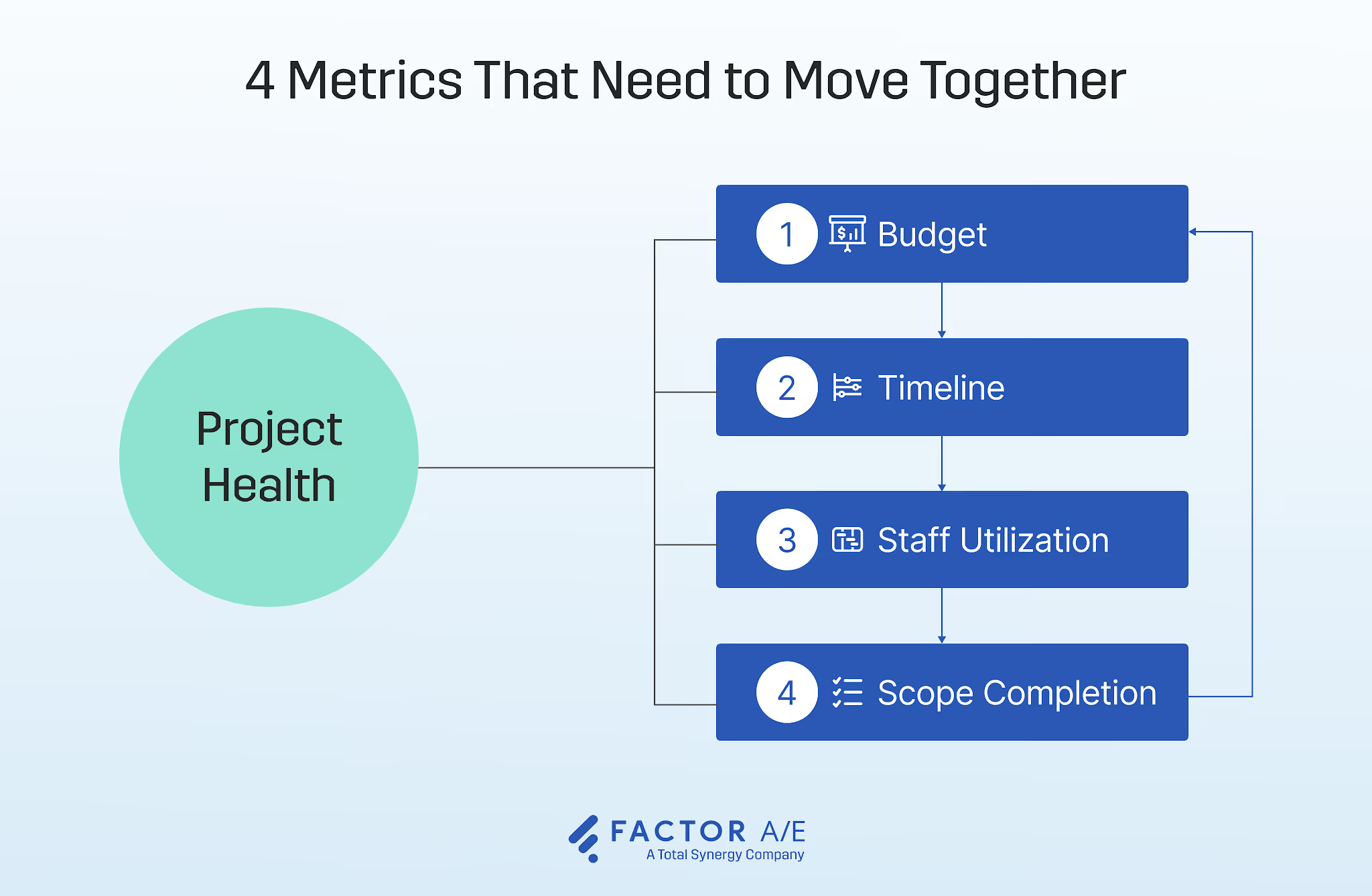
Factor AE is built around this model. It connects project execution and financial tracking in one system designed for architectural firms, so fee consumed, scope completion, schedule progress, and staff utilization are available together while a phase is still open.
Closing the Gap Between Architectural Planning and Project Financials
The six planning phases do what they were designed to do. They organize design decisions, coordinate teams, and move a project from concept through construction in a sequence that holds up under real project pressure.
The phase model was not designed to indicate whether the work in each phase is financially on track. That information has to come from somewhere else, and in most firms, it arrives too late to act on it.
Connecting financial tracking directly to phase execution changes how project managers work.
When the fee, scope, schedule, and staffing are visible together while a phase is still running, the project manager is working with current information rather than reconstructing what already happened.
Sign up for a free trial or book a free demo to see how Factor helps architecture firms connect architectural planning with project financial performance. You will explore how phase-level financial visibility helps firms manage fee, scope, schedule, and staffing as work happens, not after the phase is finished.