


By the time schematic design begins, most A&E firms have already committed to a fee, staffing plan, and schedule.
However, the information on which those decisions depend is often incomplete.
Functional requirements are still evolving. Adjacencies have not been tested. Constraints are only partially understood. Assumptions are embedded in emails, meeting notes, and individual judgment rather than being documented and aligned.
Architectural programming exists to resolve this uncertainty.
Its purpose is to create project-wide clarity before design begins by defining requirements, relationships, constraints, and assumptions in a form the firm can rely on.
But this clarity only materializes when architecture programming is treated systematically as an operational control point, rather than as a loosely structured discovery exercise.
This guide explains how to standardize architectural programming to consistently produce the clarity required for predictable scoping, staffing, and delivery across the firm.
What Architectural Programming Really Is (and Why It’s Critical for A&E Firms)
Architectural programming is the structured process for creating early-phase clarity before design begins, underpinning:
Project goals
- Functional requirements
- Spatial needs
- Relationships
- Constraints
- Success criteria
- Scoping and fees
The output of the process is a documented architectural program that serves as a single source of truth, outlining quantitative space needs, adjacency diagrams, user profiles, workflows, constraints, and explicit assumptions.
It's not another early-stage form to fill; it's a critical input for downstream project planning and delivery decisions.
How architecture programming differs from schematic design
Programming defines what must be solved in a given project.
Schematic design takes that “what” and explores how to solve those clarified requirements through form, massing, and layout.

How architecture programming differs from feasibility studies
Programming establishes clear goals, requirements, and constraints for a project.
Feasibility studies are built to test whether those clarified parameters can be achieved within budget, site, and regulatory limits.
Programming only delivers value if its outputs are used.
When requirements, adjacencies, and constraints are captured in a form the firm can rely on, they immediately begin shaping commercial and delivery outcomes.
How Strong Programming Improves Scope, Fees, Staffing, and Risk
Strong programming improves multiple aspects of project performance, but its first and most measurable impact is financial.
Fee accuracy and early-phase budgeting are where clarity, or the lack of it, shows up fastest.

Fee Accuracy and Early-Phase Budgeting
When programming is weak, teams misprice the job and burn through hours early, leading to compressed budgets in later phases.
But when clear functional requirements are set during programming, PMs can estimate hours accurately rather than guessing or relying on historical averages.
Quantitative space needs are also defined here, which influence modeling time, consultant hours, and document complexity.
This clarity allows firm principals to set fees with confidence and work together with PMs to build accurate, project-aligned budgets.
Staffing Predictability
Functional complexity and adjacency requirements determine which disciplines are needed and when.
For example, a healthcare client commissions a 6,200 m² outpatient clinic with imaging and day surgery suites. During programming, the architect documents exact room counts, zoning, equipment loads, and circulation separation requirements.
This reveals which specialist roles are required, when they are needed, and for how long they must be engaged, allowing PMs to schedule senior technical staff and clinical consultants early rather than react mid-design.
The result is stable staffing curves, fewer last-minute resource scheduling issues, and predictable delivery capacity across the project timeline.
Scope Creep Prevention
When requirements are not documented, clients assume flexibility and regularly request changes during schematic design
A lack of clear early specifications is one of the biggest contributors to scope creep, and this can be avoided with a defined program that sets boundaries for what is included and excluded. This acts as a reference point for resolving scope disputes, protecting profitability, and client relationships.
Subconsultant Coordination
MEP engineers, structural designers, and specialists rely on validated requirements and constraints. Incomplete programming forces subconsultants to make assumptions, leading to rework when needs are clarified later.
Strong programming synchronizes consultants early and reduces change cycles.
For instance, during programming for a mixed-use commercial building, the architect confirms floor load targets, plant room allowances, fire compartmentation, tenancy servicing expectations, and vertical riser requirements.
This gives structural and MEP engineers fixed constraints from which to design from day one, rather than working from assumptions.
The Architectural Programming Process: A Step-by-Step Framework

Step 1: Gather background information and define project goals
The first step is to build a foundation for future decisions and a reference point for fee validation.
Here, teams identify project intent, client drivers, performance targets, success metrics, and constraints.
It’s critical that these goals are accurately documented and don’t remain verbal. In a study on general project management, PMI reported that 39% of project failures are caused by unclear or misunderstood objectives.
Step 2: Engage stakeholders
Next, bring in stakeholder input. Perform interviews with owners, users, operators, and support staff to pull out:
- Functional needs
- Operational pain points
- Adjacency preferences,
- Experiential expectations
Use structured interview templates to ensure completeness and consistency across projects.
Step 3: Identify functional requirements, workflows, and operational patterns
Map out all tasks, sequences, operational flows, equipment needs, storage requirements, and circulation patterns.
Don’t just think about spaces; consider the behaviors that take place within them. This will give your team visibility into potential hidden requirements that could significantly affect design effort.
Step 4: Determine quantitative space needs
This step drives modeling complexity, consultant hours, and sheet production.
Define target areas, area ranges, and allowable tolerances, and validate required quantities of:
Rooms
- Zones
- Specialized spaces
Don’t skip this stage until you have completed user input or benchmarking, or you risk excessive rework.
Step 5: Map adjacencies, relationships, and circulation
Develop adjacency diagrams, bubble diagrams, matrices, and relationship hierarchies. These relationships shape massing, stacking, structural spans, and MEP routing.
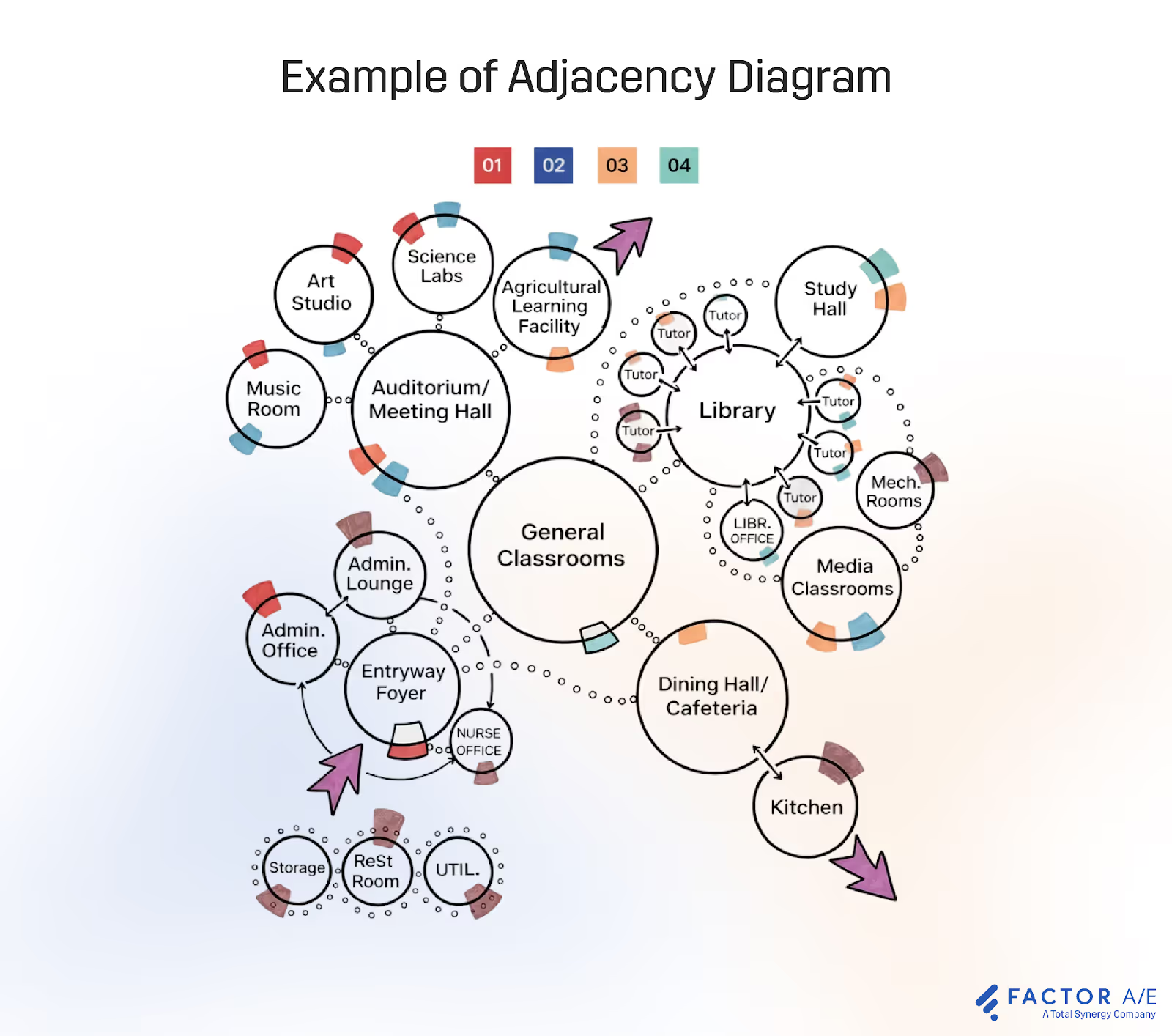
Avoid the all-too-common mistake of sketching informally rather than documenting them for team-wide alignment.
Step 6: Document constraints: site, regulatory, technical, and budgetary
Site analysis helps determine feasibility early and ensures hours and scope reflect real constraints.
At this stage, you’ll need to identify:
- Site conditions
- Engineering considerations
- Zoning limits
- Cost boundaries
Step 7: Synthesize findings into a standardized program document
When data is scattered in notes, emails, SketchUp models, interviews, and spreadsheets, there is no central source of truth to refer back to.
Solve this by compiling all interviews, spatial requirements, adjacency relationships, constraints, workflows, and assumptions into a single structured deliverable.
The program then becomes the reference for scoping, staffing, scheduling, and design decisions.
Step 8: Align with client and prepare for schematic design
Finally, present findings, confirm assumptions, resolve conflicts, and secure formal approval. This establishes a baseline for scope boundaries and reduces future disagreements.
Avoid the common error of proceeding to schematic design without client sign-off, which can lead to misalignment and redesign.
What a Strong Architectural Program Includes (Checklist)
A complete architectural program should answer yes to all of the following:
- Clear project goals and success criteria
- Are the project’s objectives defined and agreed on?
- Is there a clear definition of what success looks like?
- Defined user groups and functional needs
- Are all user types identified?
- Are their workflows, interactions, and operational needs documented?
- Quantitative space requirements
- Are target areas, ranges, capacities, and required equipment defined?
- Are quantities validated rather than assumed?
- Documented adjacencies and relationships
- Are critical relationships captured in diagrams or matrices?
- Are circulation and separation requirements explicit?
- Mapped operational workflows
- Are key tasks and movement patterns documented in detail?
- Do they reflect real operations, not assumed use?
- Explicit constraints and assumptions
- Are site, regulatory, technical, scheduling, and budget constraints documented?
- Are assumptions visible and agreed on?
Common Pitfalls in Architectural Programming (and How to Avoid Them)
Most of the problems that pop up during programming come from these four common pitfalls. Here’s how to steer clear of them.

1. Inconsistent data gathering
In many A&E firms, data gathering is not standardized.
Different PMs and designers ask different questions and use different data sources, impacting quality and consistency.
The solution here is to standardize interview questions, provide recommended sources for data gathering, and use firmwide templates and checklists to ensure consistent programming across projects.
2. Missing functional requirements or adjacencies
When you’re looking at paper plans, it's easy to fall into the trap of thinking in terms of spaces (a conference room) rather than the behaviors that occur within them (impromptu collaboration).
But this can easily lead to layout issues down the track. For example, placing a conference room next to quiet work areas without accounting for spillover conversations, informal hallway meetings, or increased foot traffic can create noise and disruption that wasn’t anticipated in the plan.
3. Failure to connect programming to fees and staffing
Often, architecture programming is treated as a standalone discovery exercise, and the information gathered during the exercise never flows into forecasting or fee validation.
This disconnect means fees are locked in before the workload is clear, leaving little room to adjust budgets when programming reveals additional coordination, engineering effort, or client expectations.
Instead, programming outputs should be integrated directly into project planning tools.
Spatial counts, adjacency complexity, regulatory constraints, and stakeholder expectations should be mapped to phase-level tasks, staffing assumptions, and time allocations before fees are finalized.
4. Weak client alignment
Mid-project client change requests are common. A key reason for this is that clients assume scope is flexible and changes are small, because programming was not formalized and approved.
The fix here is simple.
Present the program to the client before schematic design begins, and have them sign off on it before you move forward.
How to Standardize Architectural Programming Across Your Firm
When A&E teams enforce firm-wide architecture programming standards, they reduce variability, improve fee accuracy, strengthen staffing decisions, and reduce financial risk.
These six strategies are your key to building that kind of standardization:
1. Checklists
Create a required programming checklist to be completed before schematic design can begin.
Include specific prompts for user interviews, operational workflows, space drivers, adjacency needs, site constraints, and known assumptions. Make completion mandatory and visible to PMs and principals, not optional or informal.
2. Templates
Define a single approved program document structure and require all projects to use it. Lock the core sections so teams cannot skip or reorder them, and allow limited flexibility only where project type demands it.
3. Quality assurance
Add a formal programming sign-off step led by the project manager or principal in charge. Require them to review the program against the checklist, confirm assumptions are explicitly documented, and approve it before fees, schedules, or staffing plans are finalized.
4. Integration into downstream planning
Map specific programming outputs to downstream planning inputs. For example, link space counts toward modeling hours, adjacency complexity toward coordination time, and user workflows toward consultant involvement.
Require teams to reference these inputs when building schedules, staffing plans, and fee breakdowns.
5. Interdisciplinary handoffs
Run a structured programming handoff meeting before schematic design begins.
Use the program document as the agenda, walk through the requirements and constraints section by section, and capture any unresolved questions before design work starts
6. Technology adoption
Centralize programming data instead of storing it in PDFs, emails, or slide decks.
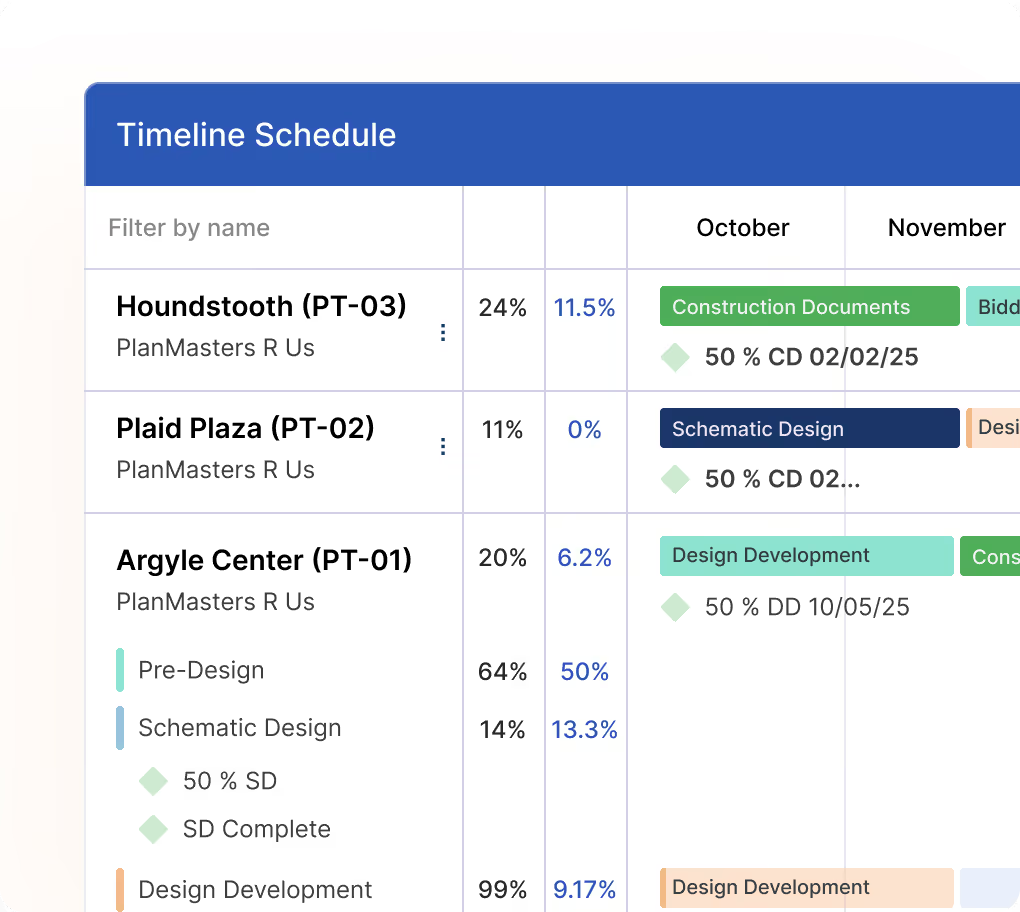
Enter requirements, assumptions, and space data in a way that can be referenced directly when building budgets, assigning staff, and forecasting hours, ensuring programming decisions remain connected to project execution.
Turn Programming Into a Firm-Wide Control Point
Strong architectural programming is not about producing more documentation; it's about creating reliable inputs that firms can use to scope work, price fees, plan staffing, and manage risk with confidence.
When programming is standardized and treated as an operational control point, uncertainty is reduced early, decisions improve downstream, and projects remain predictable and profitable.
Supporting this discipline with purpose-built architecture software ensures programming data stays connected to budgets, staffing plans, and forecasts, turning early clarity into sustained operational control.
Discover how Factor transforms A&E firms. Request a demo.
FAQ
What is architectural programming?
Architectural programming is a structured, early-phase process that converts uncertainty into documented requirements, constraints, and assumptions.
When treated systematically, it provides the operational inputs firms rely on to scope work accurately, price fees, plan staffing, and reduce delivery risk.
What should an architectural program include?
A complete program documents the following information:
- Project goals
- User groups
- Workflows
- Quantitative space needs
- Adjacency relationships
- Constraints
- Explicit assumptions
These elements create a single source of truth that supports accurate scoping, predictable staffing, and reliable scheduling decisions.
How does programming improve scope, fees, and staffing?
Early documentation of requirements and constraints provides PMs with reliable inputs for hours, scope, and staffing.
Teams price work more accurately, define firmer scope boundaries, and assign resources based on verified complexity rather than assumptions.

Recommended articles
.avif)

See Factor in action
In one quick call, we’ll show you a simpler way to run projects and get paid faster.
.png)
“I recommend Factor to other firms. The team is great, it’s easy to use, and it has streamlined my project management. It can do the same for yours.”
Adam Mayberry
Architect / Managing Principal


