



For architects and engineers, "AIA billing" often refers to two different parts of the same project.
One involves reviewing and certifying a contractor's payment application, and the other is billing your own design services as work is completed.
Since those workflows happen alongside each other, it's easy to treat them as the same billing process, but they're not.
One of those workflows belongs to the contractor, who requests payment from the owner using the G702 and G703 forms. As the architect, your role is to review and certify those applications as part of construction administration, not to submit them yourself.

For your professional services, you invoice the owner under your owner-architect agreement as you complete the phases of work you agreed upon.
The two workflows support the same project, but they serve different purposes and rely on different documents.
Understanding that distinction is only the beginning because preparing an invoice is about knowing the work your firm has actually earned before the invoice goes out.
When that judgment is unclear, billing becomes slower, client questions become harder to answer, and project performance is much more difficult to see.
We'll explain how contractor payment applications fit into construction administration, how to bill your professional services, and why accurate AIA billing depends on more than following the forms.
What is AIA Billing?
AIA billing is the payment framework used on construction projects to document, review, and approve payments as work progresses. Developed by the American Institute of Architects, it combines standard contracts with payment documents so owners, architects, engineers, and contractors follow the same billing process throughout a project.
AIA billing exists because construction projects are paid for over months or years rather than in a single payment. Each invoice reflects work completed during that billing period, giving owners confidence they're paying for work that has actually been delivered.
For architecture and engineering firms, the framework standardizes how payment is documented and administered. It doesn't determine how much of your professional fee you've earned. That judgment still belongs to the project team and sits behind every percentage you bill.
AIA billing vs. progress billing
Progress billing is a payment method that breaks the total contract value into stages, with each invoice reflecting the work completed during that billing period.
AIA billing applies that approach through standardized contracts, payment forms, and a schedule of values.
The two are not competing methods. Progress billing describes how payments are made over the life of a project. AIA billing provides the standardized framework for documenting, reviewing, and approving those payments.
The framework standardizes the process. It doesn't determine how much progress your firm has actually made. Before you can prepare an invoice, the project team still has to decide what work has been earned during that billing period.
The Core AIA Billing Documents
Preparing an AIA bill means moving between three documents. One establishes what you can bill, another summarizes the payment request, and the third shows how you calculated the total.
The schedule of values
The schedule of values is the foundation of every subsequent client invoice. Before you bill any dollar, you divide the total fee across the project's phases so every part of the work has a value attached to it.
From that point on, you bill against those phases, not against individual deliverables, meetings, or hours worked.
For architecture and engineering firms, those phases usually follow the structure already set out in the owner-architect agreement (AIA B101): schematic design, design development, construction documents, procurement or bidding, and construction administration.
Unlike a contractor's schedule of values, which breaks construction into line items such as concrete or steel, yours divides the professional fee into the project phases of service you agreed to deliver.
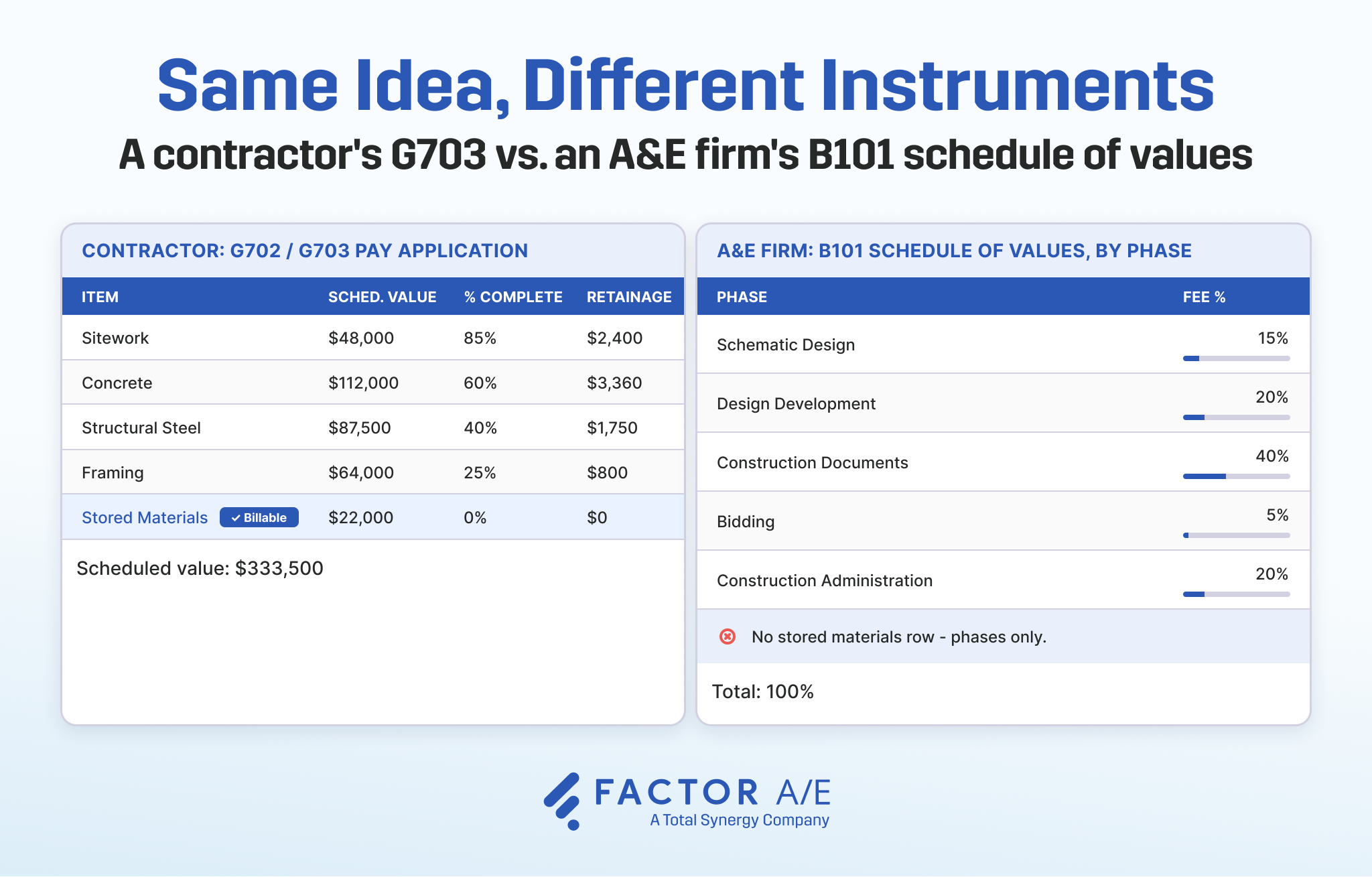
Every percentage-complete decision you make later depends on this breakdown. If the schedule of values doesn't reflect how you plan to deliver the work, defending your billing becomes harder as the project progresses.
The G702
The G702 summarizes the payment application for a single billing period. It brings together the contract sum, approved changes, work completed to date, retainage, previous payments, and the amount currently due on a single page.
The G702 gives owners and architects a single-page summary of what the contractor is requesting to be paid during that billing period.
The G703
The G703 shows how the G702 reached that number, breaking the schedule of values into individual phases or line items. It also records the scheduled value, work completed in previous billing periods, work completed this period, the total earned to date, and the remaining balance.
Where the G702 gives the total, the G703 shows the calculation behind it.
Reconciling the G702 and G703
The G702 and G703 only work when they agree with each other. Every line on the G703 rolls into the total shown on the G702, and those numbers have to match.
When they don't, the problem traces back to a change that never made it into the continuation sheet or a percentage complete that the supporting detail doesn't justify. Reviewers don't need to find the mistake to reject the application.
If the summary doesn't reconcile with the details, the application comes back for correction, and the billing cycle restarts.
How the AIA Billing Process Works For A&E Firms
The documents above provide the structure, but the billing cycle begins when you apply that structure to the work your team completed.
For each billing period, you decide how much progress you've made in every active phase, bill against the schedule of values, and carry that progress forward into the next invoice.
Billing by phase
Every billing period starts with the same question: How much of this phase have we earned this month?
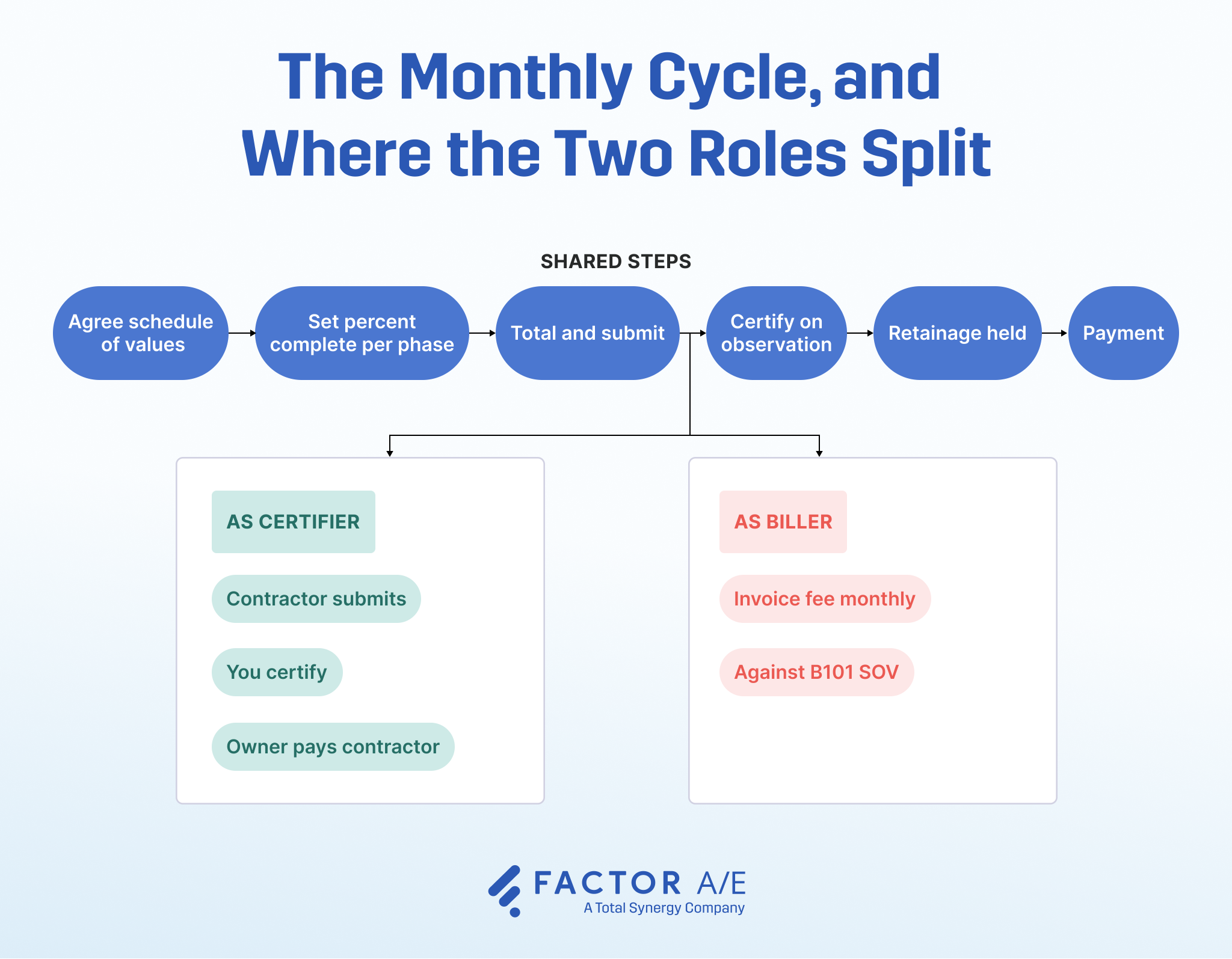
Before anyone prepares an invoice, the project team must agree on the extent of progress made in each active phase.
The schedule of values sets the value of each phase. Your percentage-complete assessment determines how much of that value you've earned during the current billing period.
Once the team agrees on that percentage, calculating the invoice is straightforward: subtract what you've already billed and invoice the balance earned.
The arithmetic rarely causes problems, but determining what the firm has earned can be challenging. The work should explain why Design Development is 65 percent complete, not your firm's billing target.
That's why firms rely on project management systems that tie phase progress, budgets, and billing together instead of reconstructing that picture at month-end.
Does retainage apply to design fees?
During construction administration, you review contractor payment applications every month. Those applications often include retainage, with the owner withholding a percentage of each payment until substantial or final completion. That raises an obvious question: Does retainage apply to your firm's invoices as well?
Retainage protects the owner under the construction contract, and it is not a standard feature of the owner-architect agreement. Unless your contract specifically requires it, owners pay your professional fee without withholding a percentage from each invoice.
The main exceptions are public-sector work and some larger engineering contracts, where retainage may form part of the agreed payment terms.
How design firms protect their fees
Protecting the fee starts before you prepare the first invoice. Most of that work happens in the agreement: deciding how payments will be made, when work pauses, and how changes to the scope will be handled.
Some firms collect a mobilization payment or deposit before work starts and apply it to the final invoice. Others make payment at the end of each phase a condition for starting the next one.
In some cases, firms reserve the right to pause work when invoices remain unpaid. The approach varies from firm to firm, but the objective is to reduce payment risk before it becomes a collections problem.
Scope deserves the same discipline. Additional work only becomes billable when the agreement changes. Document additional services before the work begins, not after the invoice is questioned. When you leave scope changes as conversations, they often become work the firm struggles to recover from.
The firms that handle this consistently don't rely on memory or spreadsheets alone, rather, they build these decisions into the way they manage projects day to day.
Where AIA Billing Breaks Down
While the mechanics of AIA billing are straightforward, mistakes usually happen earlier, when you are setting the fee, assessing progress, or letting project changes outpace the agreement.
By the time those issues appear on an invoice, the billing problem has already happened, and it’s much harder to fix.
Confusing contractor billing with design-fee billing
The two billing processes run alongside each other, and you might carry assumptions from one into the other.
Architects and engineers review contractor payment applications throughout construction, then turn around and invoice their own professional fees.
The documents move through the same project, but they serve different contracts.
That distinction matters because contractor payment applications revolve around the G702, G703, retainage, and construction progress. Your design fee is based on the owner-architect agreement, your schedule of values, and the professional services you've delivered.
Treat one process like the other, and expectations begin to drift. Firms start looking for retainage where none exists, assume the same documentation applies to both invoices, or measure progress using the wrong benchmark.
Building a schedule of values that doesn't match the work
The schedule of values should reflect how your team actually plans to deliver the project. When it doesn't, billing becomes more difficult with every invoice.
A common mistake is copying a standard percentage split without considering the project's scope, complexity, or delivery approach. The allocation may look reasonable when the agreement is signed, but it quickly creates problems if the work doesn't unfold the way the schedule assumes.
A phase that runs longer than expected appears over budget before the work is complete, while another phase may carry a fee that was effectively earned months earlier.
The schedule of values should reflect how the project will actually be delivered, because every percentage you bill will be measured against it.
If you build it around a template, you'll spend the rest of the project explaining why the numbers no longer match reality.
Letting scope changes stay verbal
Scope rarely changes all at once. It grows one request at a time: another coordination meeting, another design option, another round of revisions, another site visit.
None of those requests feels significant on its own, which is why firms often keep working before anyone updates the agreement.
That's where fees start leaking. Additional work becomes billable when both parties agree to change the scope, not simply because more work was done.
The longer that conversation waits, the harder it becomes to separate services included in the original fee from services that should have been billed separately.
Why a Compliant Invoice Can Still Be Wrong
Every invoice depends on a percentage-complete assessment. Getting that percentage right matters because many firms don't see project problems until they're already affecting profitability.
Factor's 2026 A&E Industry Benchmark Report found that 40% of firms don't track project profitability in real time, while 73% identify scope creep as their biggest budget killer.
By the time those issues show up on an invoice, there's often little room left to recover the margin.
So the question is whether the percentage you're billing reflects the work the firm has actually earned.
An AIA payment application can't answer that for you. The G702 reconciles to the G703; the totals add up, and every required field is complete. That proves the application is compliant. It doesn't prove the percentage behind it is right.
To answer that question, you have to step outside the forms. A phase that's 65 percent complete after using 65 percent of its budget tells a different story from one that reached the same percentage after consuming 90 percent of the fee.
The invoice may look identical, but the project is in a very different position. A percentage only means something when you can explain the work behind it, understand how much of the fee it has consumed, and know whether the project is where it should be by now.
That's where Factor fits. It doesn't replace the AIA billing process or produce different forms. It helps you understand whether the percentage you’re billing reflects the project's reality before the invoice goes out.
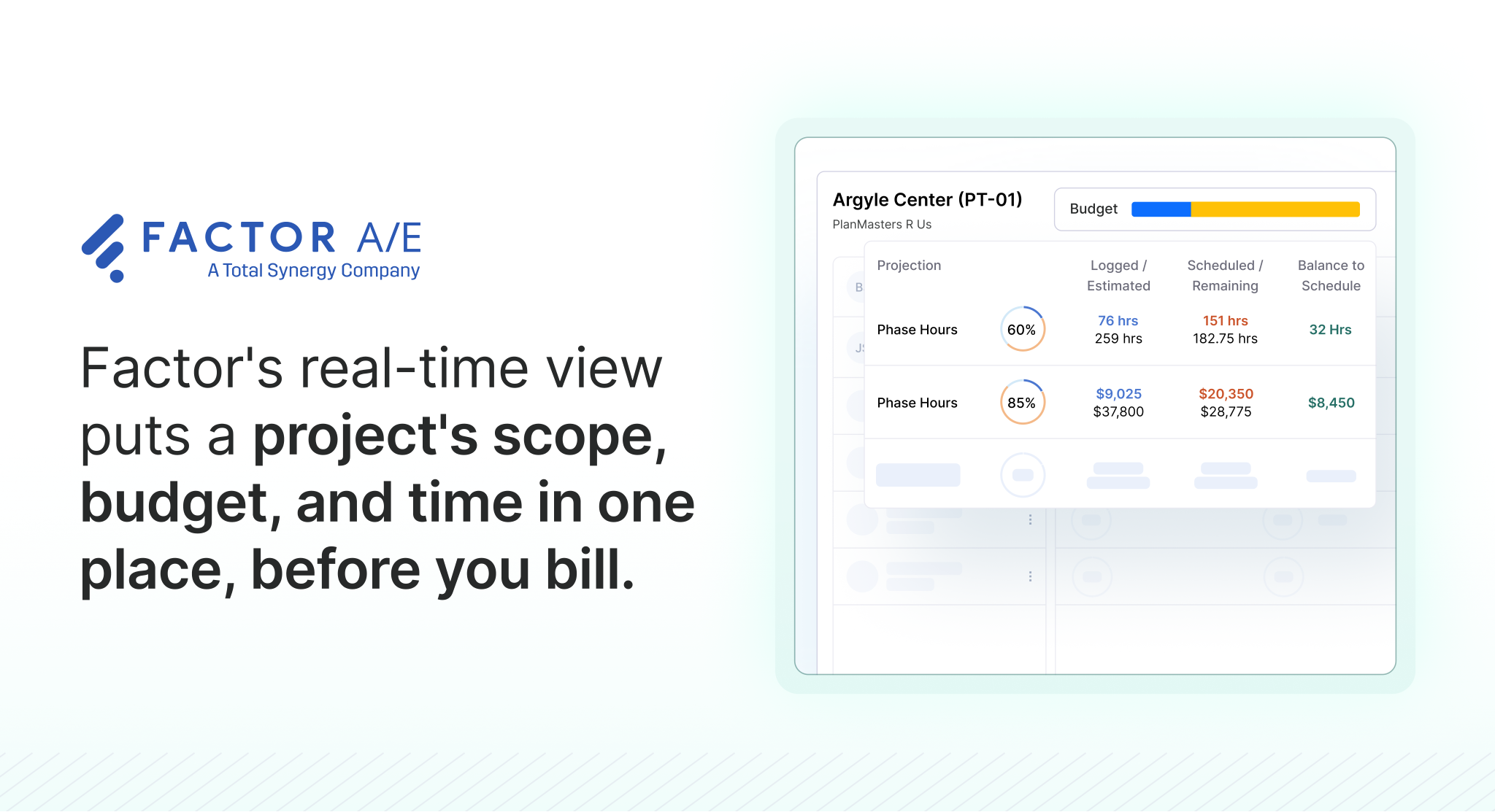
By bringing scope, budget, and schedule together in one place and synchronizing this information with QuickBooks Online in real time, everyone works from the same numbers rather than reconciling different versions after the billing period closes.
Good AIA Billing Starts Before the Invoice
The AIA standardizes how construction projects document progress. It doesn't determine whether the progress being billed reflects the project's financial reality. That judgment still belongs to the project team.
The firms that bill with confidence aren't simply better at completing the G702 or reconciling the G703.
They know what they've earned before preparing the invoice because they understand the project well enough to defend every percentage they bill.
If your team is spending more time reconstructing project performance than managing it, the problem usually isn't the forms. It's the information behind them. Factor brings project budgets, phase progress, and billing together in one place, so you can understand the number before it reaches the invoice.
Start with one active project, then set up your phases, track progress against the budget, and see how much easier billing becomes when the project and the invoice tell the same story.


Recommended articles



See Factor in action
In one quick call, we’ll show you a simpler way to run projects and get paid faster.
.png)
“I recommend Factor to other firms. The team is great, it’s easy to use, and it has streamlined my project management. It can do the same for yours.”
Adam Mayberry
Architect / Managing Principal


