



The A&E industry is shifting faster than most firms can respond.
Fee pressure, talent gaps, AI adoption, new delivery models, and rising compliance demands are not new topics of conversation. What is new is that they are all happening at once, on top of firms that are already stretched.
Growing firms are investing in the right areas. But the investment hasn't translated into margin improvement because the underlying delivery model hasn't changed. Scope still drifts, and budgets still bleed.
Profitability is still something firms discover at closeout, not something they manage while the job is live.
So the question isn't which trends to track but whether your delivery model can support acting on any of them.
Here are six trends shaping the A&E industry in 2026 and what each one actually requires inside a firm that wants to act on it.
1. AI Adoption Is Accelerating, but Capability Is Not Keeping Pace
Most firms already use AI in some part of their workflows. Teams assemble proposal drafts faster. They search specifications more easily. Meeting notes and documentation tasks take less time than they used to.
What has not changed is how a project moves through the firm. A team drafts a specification faster, then drops it into the same email thread. A project manager still manually reconciles time logs against a phase budget, usually long after the team has moved on to the next phase. AI sped up certain tasks. It did not change the systems those tasks feed into.
Factor AE’s 2026 A&E Industry Benchmark Report found that 78% of firms expect AI and automation to have the biggest impact on the industry in the years ahead.
Those same firms report that 7 in 10 still manage resources manually through meetings, spreadsheets, or no formal process at all.
The tools are arriving faster than firms are restructuring the workflows underneath them.
RIBA’s 2025 AI Report points to the same tension. AI adoption across A&E practices rose from 41% to 60% in a single year, but the report focuses less on adoption itself and more on governance, data integrity, and what responsible implementation actually looks like inside a practice.
RICS’ 2025 global construction survey adds another constraint: firms rarely embed AI deeply across delivery workflows, and the biggest barrier is not a lack of access to tools. Firms lack staff with the operational and technical knowledge required to integrate those tools into existing workflows.
Factor AE sees the same pattern repeatedly across firms. The workflow underneath the AI still looks largely the same. Teams track budgets in one spreadsheet. They manage staffing plans differently. Project teams discuss scope changes in meetings, then manually update the records later, if at all.
Inside some firms, teams jokingly call the situation “spreadsheet prison.” The name sticks because the problem feels familiar. Project information moves across disconnected files, inboxes, and manual handoffs, relying heavily on memory and individual follow-through. Adding AI to that environment does not remove the fragmentation. It accelerates work inside the same fragmented system.
Before firms further expand their use of AI, they need to examine the underlying workflow. If project handoffs still rely on disconnected spreadsheets, inboxes, and verbal check-ins, AI will exacerbate the same coordination problems that are already slowing the firm down.
That is usually the better starting point: not another tool, but a clear audit of how project information moves through the business.
How to act on this trend
- Map your last three projects from estimate to closeout and identify every handoff that still runs through email, a shared drive, or a manually updated spreadsheet. Those are the leaks, and AI running on top of them will not close them.
- Before adding new AI tools, document which two or three workflows would benefit most from speed gains and what the quality check looks like for each. Adoption without a quality gate increases liability exposure.
- Measure by outcome, not activity. The question is not how many tools the team is using. It is time to complete a governed workflow and to determine whether rework rates have held steady.
For most firms, the honest answer is that delivery data is structured but not connected to the flow of money. That is the problem the next trend examines.
2. Data-Centric Delivery Is Becoming the New Baseline
Most firms can point to meaningful progress in their digital workflows. BIM models are more structured. Common Data Environments are more widely adopted. Teams use standardized naming conventions, shared documentation systems, and digital coordination tools across projects.
NBS’ 2025 benchmarking report reflects that shift, describing the sector as approaching a digital tipping point as firms expand their use of digital tools across project delivery.
But the operational reality inside many firms still looks very different once a project moves into active delivery.
A principal asks how the project budget is tracking. The PM opens a spreadsheet. Not a live financial dashboard. A spreadsheet someone updated when they had time.
That is the disconnect. The project data exists, but it still does not connect cleanly to the place where financial decisions happen.
Teams log hours against project phases every day, but the cost picture does not update in real time.
A PM cannot immediately tell whether an active project is financially healthy or quietly drifting toward an overrun. The team only sees the full picture later, usually after the month-end reconciliation closes the billing cycle and narrows the available options considerably.
Factor AE’s 2026 A&E Industry Benchmark Report found that 40% of firms do not track project profitability in real time, while 60% either do not track realization rates or are unsure of them.
That is why digital maturity in A&E now depends less on whether firms collect project data and more on whether teams can use that data operationally while work is still in progress.
The more useful test is simple: can a project manager pull up the live financial status of an active project right now, without waiting for accounting to run a report?
If the answer is no, the firm may have digitized documentation workflows, but it still manages project financial control reactively.
How to act on this trend
- Run that test today across your five most active projects. Ask each PM whether they know, without running a report, whether their project is on track financially against the phase budget. Where the answer is no, that is where cost is accumulating invisibly.
- Close the connection between time entry and phase-level budget tracking before adding more tools. The problem is not a missing tool. It is a missing connection between the tools already in place.
- If your monthly invoicing cycle takes more than ten days to close, that is a signal. It means financial data is not flowing cleanly from project to billing. Find where the manual reconciliation is happening and start there.
The firms that tried to move to fixed-fee billing and pulled back made a reasonable decision. Their systems could not support the level of confidence the model requires. That is the next problem.
3. Fixed-Fee Billing Is Growing, and Most Firms Are Not Ready for It
Most A&E principals already understand the upside of fixed-fee work. Yet many growing firms still default to hourly billing.
The hesitation is usually not philosophical. It is operational.
To price a fixed-fee project confidently, a firm needs to understand how similar projects actually performed at the phase level. Where did labor hours drift? When did the budget begin separating from the scope? Which phases consistently absorbed more time than expected?
Many firms still cannot answer those questions clearly in real time.
Factor AE’s 2026 A&E Industry Benchmark Report found that 42% of firms cannot report their own profit margin.
That number explains the hesitation more clearly than any market trend. Firms cannot price confidently from a financial baseline they cannot fully see.
The warning signs often appear early, but many firms do not detect them until much later. Factor AE customers sometimes describe the pattern as “busy but bleeding.” The schedule looks healthy. The team stays fully utilized. Meanwhile, 50% of the project budget disappears at 20–30% scope completion.
By the time the firm recognizes the overrun, the project has already moved too far downstream. The remaining options narrow quickly: absorb the loss internally or reopen a difficult budget conversation with the client after the work has already expanded.
WTW’s 2025 Insurance Marketplace Realities report adds another layer of pressure. The report found that 85% of A&E professional liability carriers cite increasing claim severity. Firms moving toward fixed-fee contracts without strong visibility into scope and costs are not simply taking on margin risk. They are taking on operational and liability risk that they may not detect until late in delivery.
The firms succeeding with fixed-fee work usually built the operational foundation first. They track project performance at the phase level. They compare billable rates against actual labor costs in real time. Most importantly, they can identify budget drift while the project still has room for correction.
That changes the economics of fixed-fee work entirely.
Without that visibility, fixed fees feel dangerous. With it, firms can use fixed pricing as a genuine competitive advantage.
How to act on this trend
- Pull up the last three projects you completed and identify the phase in which the hours logged first exceeded the budget. That is the pattern that will repeat on every fixed-fee engagement until the tracking changes.
- Implement dual-rate tracking and billable rate against actual pay rate on your next two projects before discussing any fixed-fee repricing. You need that picture before you can price accurately.
- Ask your PM team when they first realized the budget on the last project was at risk. If the answer is “when billing closed” or “at final invoice,” the firm identified the problem too late to manage it.
The same blind spot driving fixed-fee hesitation is also driving the talent problem. It just shows up differently.
4. The Talent Shortage Is Structural, and Hiring Alone Will Not Solve It
A new project comes in. The principal looks across the team and assigns the work to whoever seems least overloaded.
There is no live utilization view. No phase-by-phase workload projection. Project leaders rely on instinct, memory, and scattered check-ins to judge capacity.
The problem usually appears later. Two months into the project, someone is quietly working sixty-hour weeks on a scope originally planned for forty. Nobody flagged the overload because the PM thought the project was still manageable, and leadership had no live picture of where the workload was actually landing.
ACEC’s 2025 Workforce of the Future research points to broader structural pressures: retirements continue to outpace new entrants, while firms struggle to replace experienced architects and engineers quickly enough to meet demand.
But many firms are also creating internal operational pressure. Factor AE’s 2026 Benchmark Report found that 50% of firms assign staff to projects based primarily on gut feel, while 40% cite managing project demand with current staff as their biggest people challenge.
Those problems reinforce each other.
Firms often interpret burnout and turnover as purely hiring problems when the underlying issue is a lack of visibility into workloads. Teams repeatedly absorb overruns, scope drift, and uneven project distribution without anyone seeing the pressure build up early enough to rebalance.
Hiring into that environment rarely fixes the pattern. The new hire enters the same assignment system, faces the same visibility gaps, and eventually falls into the same overload cycle.
Firms that handle staffing pressure more effectively tend to start with a simpler question: Where is the workload actually landing right now?
That answer usually reveals more than another hiring plan does.
How to act on this trend
- Before the next hire, run actual utilization data on your current team for the past 90 days. Find out where the overload is actually occurring and whether it is a capacity or distribution problem.
- Replace the mental model of "who seems available" with a live view of actual hours logged against phase budgets across active projects. The assignment decision should come from that picture, not from a Friday morning read of who looks busy.
- When someone resigns, ask which projects they were working on and how those projects were tracking against phase budgets. If the same project types keep appearing, that is a scoping or tracking problem, not a retention problem.
The same delivery model that generated these outcomes will be tested more rigorously as firms move into the sectors where growth is currently concentrated.
5. Demand Is Shifting Toward Data Centers and Energy Infrastructure
Firms that spent the last decade delivering tenant improvements, commercial office fit-outs, and mixed-use residential are getting calls about data center enabling works, grid upgrades, and energy facility support.
The project type is different. The program is faster. The client is less patient. And the coordination requirements are in an entirely different category.
ACEC's 2025 research identifies data centers and energy utilities as among the leading market drivers for engineering firms right now, with backlogs running high.
Deloitte's 2026 Engineering and Construction Outlook frames this as a structural shift, not a cyclical one, while flagging the conditions surrounding it: tariffs, supply chain disruptions, material price volatility, and labor shortages that tighten margins for firms without standardized operations.
McKinsey's 2025 analysis puts the capital requirements for data center scaling through 2030 at a scale that removes any doubt about the long-term demand picture.
The opportunity for growing A&E firms is real. Specialist sub-consultancy, permitting packages, MEP coordination, owner-side advisory: there is durable work here for firms that can deliver reliably at pace. The constraint is that these projects do not absorb operational drag the way slower commercial work sometimes does.
A phase that runs 15% over budget on a tenant improvement is a conversation. On a data center project with a client tracking every line item and a compressed schedule, it turns into a dispute.
Factor AE's 2026 Benchmark Report found that 54% of firms plan to expand services or enter new markets in the next 12 to 24 months. The appetite is real. The question worth asking before committing is whether the delivery system can actually track costs and scope at the pace at which these projects move.
How to act on this trend
- Before pursuing work in a new sector, take your last three completed projects and ask whether you could have caught a phase budget overrun within the first two weeks of it happening. If the answer is no, that is the gap a faster-moving project will expose first.
- Pick one project type in the target sector and define what "on track financially" looks like at the end of each phase. If you cannot define it, you cannot manage it.
- Use the AIA Architecture Billing Index to track forward workload signals before committing resources. The demand is structural, but timing the entry still matters.
The shift in delivery models, occurring alongside this sector's demand pull, further sharpens the same question.
6. Design-Build is Reshaping Project Delivery and Who Bears the Risk
Design-build is gaining ground because owners want a single point of accountability. Fewer handoffs and faster delivery.
DBIA's 2025 Design-Build Data Sourcebook projects design-build approaching 50% of relevant construction spending by 2028, and the performance advantages that keep attracting owners, faster schedules, and lower cost growth, are well-documented.
AIA has updated its contract suite to give architects better protection in design-build and progressive design-build arrangements, which suggests the liability conversation has been going well.
The claims data makes that context clear. WTW's 2025 Insurance Marketplace Realities found that 85% of A&E professional liability carriers cite increasing claims severity, with AI-assisted workflows and data-heavy deliverables named as emerging contributors.
AIA's 2026 Architecture Billing Index shows a meaningful share of firms increasing their professional liability coverage over the past three years. The delivery model is getting more collaborative. The exposure is not getting smaller.
What tends to go wrong in bad design-build outcomes is not a contract or client selection problem. It is a scope-and-cost-tracking problem that the delivery model makes harder to contain. In a traditional design-bid-build engagement, scope drift and coordination gaps often surface late, but usually within a defined lane.
In a design-build arrangement, where the architect assumes greater risk and coordination responsibility, the same gaps can lead to disputes more quickly. A change order that goes undocumented for three weeks. A scope addition that never makes it into the fee. A subcontractor coordination failure that the design team is now partially on the hook for.
Firms that navigate design-build well are not necessarily the largest or most experienced. They are the ones who know, at each phase, whether scope and cost remain aligned. That is what lets them have the hard conversation early, before it becomes a claim.
How to act on this trend
- Before pursuing design-build work, define the minimum internal tracking requirements for that contract type: how scope changes get documented, who approves them, and how quickly they are reflected in the project budget. If that process does not exist, the contract will move faster than the firm can manage.
- For every active design-build engagement, confirm that the PM can tell you right now the budget status of each active phase and the last time the scope was formally confirmed with the client. Those two data points tell you whether the project is being managed or just being delivered.
- Review your professional liability coverage against the project types you are actively pursuing, not the ones you were doing three years ago. If the project mix has shifted toward collaborative delivery, the coverage conversation should reflect that.
Visibility Separates the Firms That Improve Margins From the Ones That Can't
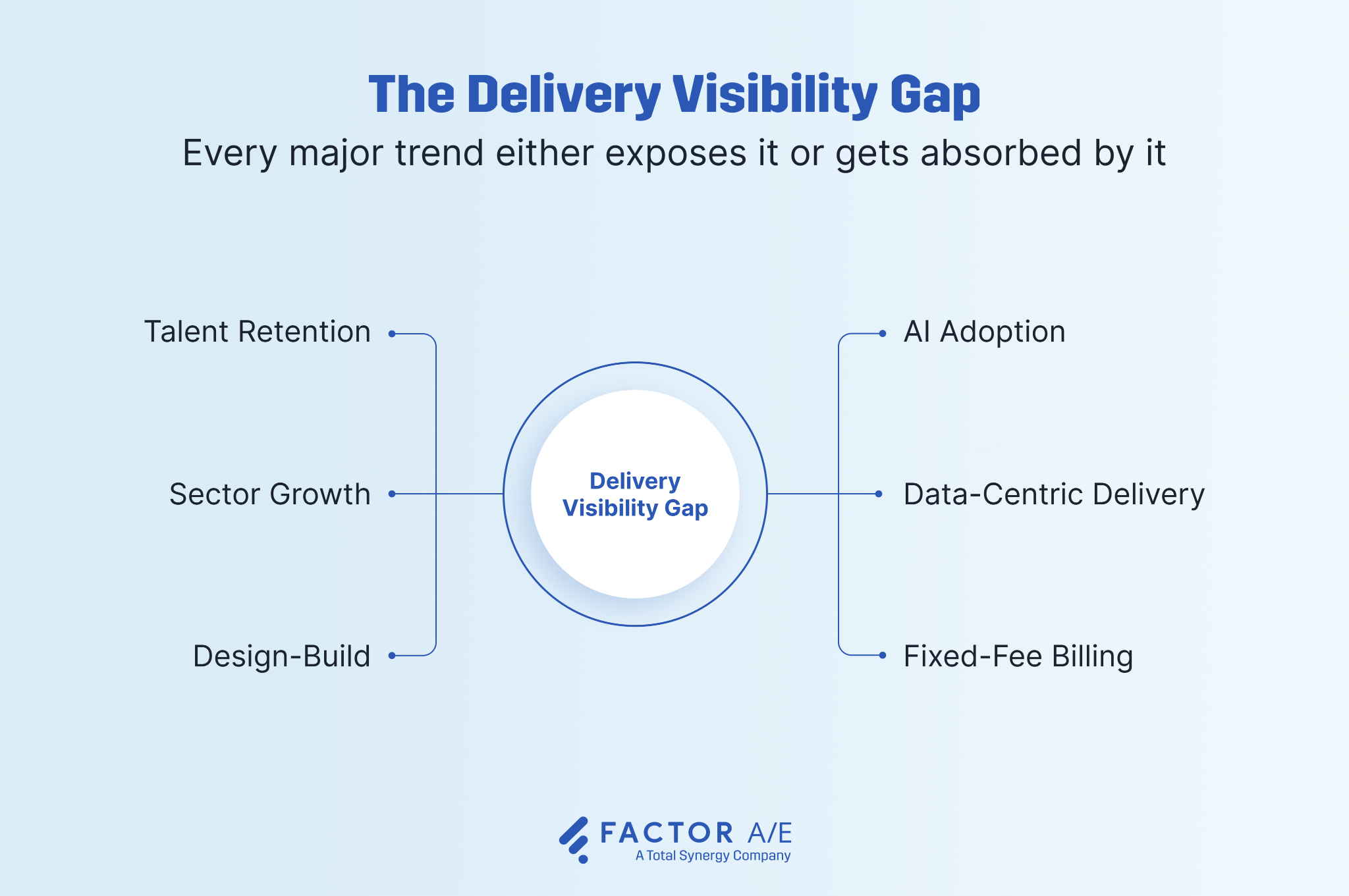
Every trend in this article eventually runs into the same operational constraint: firms cannot manage what they cannot see clearly while the project is still live.
Budget drift, scope creep, burnout, and shrinking margins often come from the same underlying issue: delayed visibility. Teams discover problems after billing closes, after labor overruns accumulate, or after the schedule absorbs work that was never scoped properly.
The firms responding well to these pressures are not necessarily using more tools. They are seeing project financials, workload distribution, and scope alignment early enough to act before the damage compounds.
Factor AE gives A&E firms operational visibility through phase-level budget tracking, PM-to-finance visibility, and real-time project health tracking across active work.
See how Factor AE gives A&E firms unmatched visibility into their project portfolios.

Recommended articles
See Factor in action
In one quick call, we’ll show you a simpler way to run projects and get paid faster.
.png)
“I recommend Factor to other firms. The team is great, it’s easy to use, and it has streamlined my project management. It can do the same for yours.”
Adam Mayberry
Architect / Managing Principal


