



A strong project comes in through a past client. It's a good fit, a solid budget, exactly the kind of work you want more of.
That’s great. The problem is that you have no control over when the next one arrives.
Between those moments, the pipeline depends on referrals, timing, and who happens to think of your firm at the right time.

While architecture firms' websites are credible and visually polished, they often do little to help new clients find the firm.
That gap matters more now than it used to. Research from Gartner shows that buyers prefer to research independently before ever speaking to a company. By the time they reach out, they have already filtered their options.
If your firm does not show up when someone searches for the kinds of projects you design, it usually does not make the shortlist.
This guide breaks down how SEO for architecture firms actually works, why most firm websites are difficult to find, and where to start without taking time away from billable work.
What is SEO for Architects?
SEO for architects is the process of helping your firm appear when potential clients search for the kinds of projects you design.
For architecture firms, that usually means improving how clearly your website communicates three things:
- What types of projects do you work on
- Where you work
- Who you work with
Search engines use those signals to decide when your firm is relevant to a search. The clearer and more specific the signals are, the easier it becomes for the right clients to find you.
Why Many Architecture Websites Fail at SEO
The typical architecture website is a portfolio. That makes sense because the work is visual and the brand matters. However, a site can look impressive and still be difficult to find.
Archmark reviewed more than 5,500 architecture firm websites and found that many were not structured to be discovered by prospective clients online. The issue was rarely the quality of the work itself. The sites described expertise too broadly for search engines to confidently match them to the right searches.
Architecture searches are usually narrow and specific. Clients are looking for someone experienced with a specific project type in a specific location, often under specific constraints.
Search engines cannot infer that from photography alone. They rely on language: project descriptions, service pages, location signals, and the kinds of clients the firm describes.
There is a measurable difference between “we design beautiful spaces” and “we design custom residential additions for homeowners in Denver, including hillside sites.” The first gives search engines very little to work with. The second clearly signals what the firm does and who it is relevant for.
How SEO Helps Your Architecture Firm
SEO does more than increase traffic to your website. Done well, it increases visibility, improves inbound fit, and raises the likelihood that the people reaching out already understand the kind of work your firm does best.
A second path to inquiries beyond referrals
Architecture firms still grow through referrals, but SEO creates another way for clients to find them: showing up when someone searches for a specific type of project.
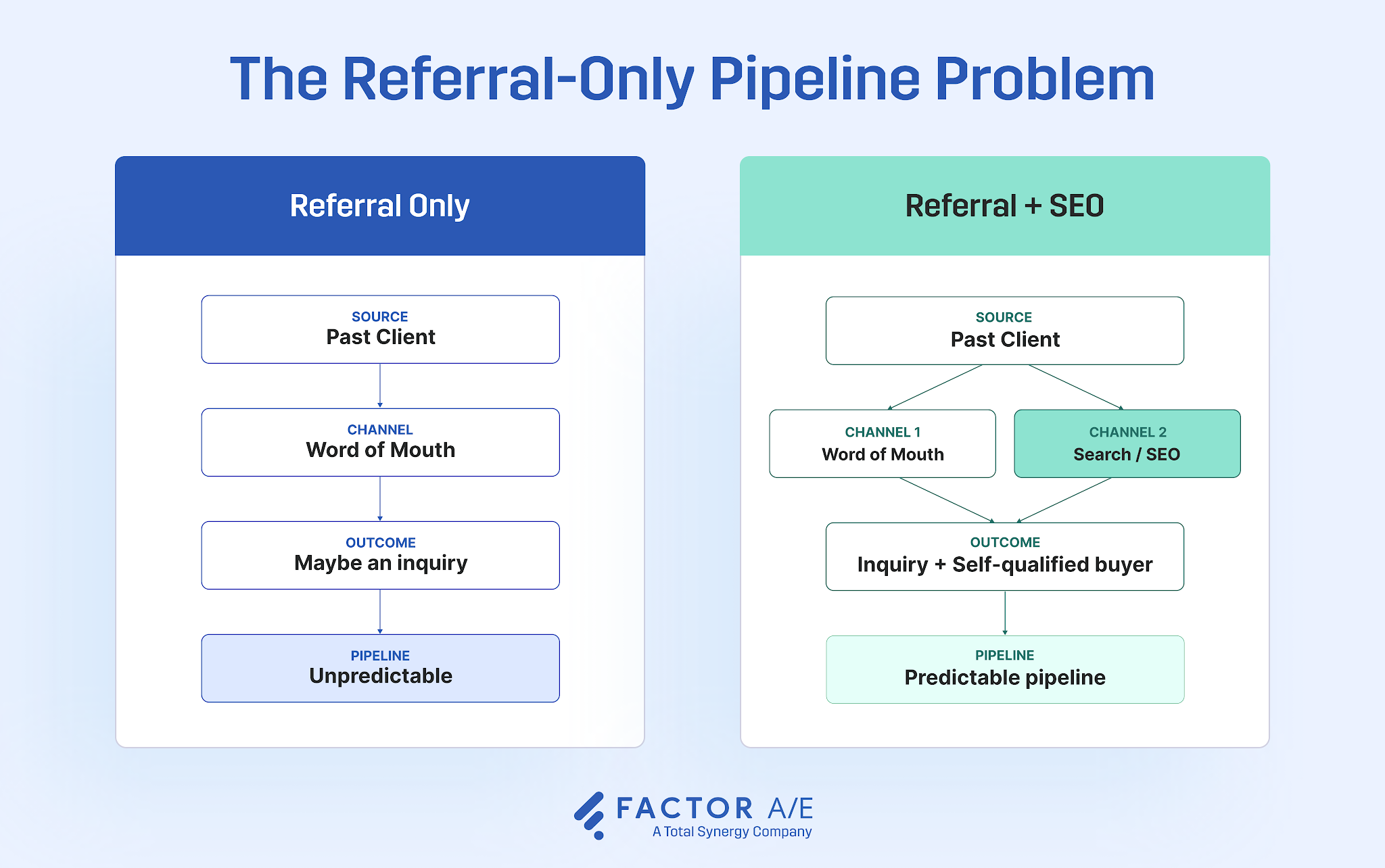
Those searches are usually highly intentional. A homeowner may look for a residential architect experienced with hillside sites. A restaurant owner may search for a firm that has designed hospitality spaces before. Someone planning an addition may search for an architect in their city who already works on similar homes.
When your firm appears in those searches, the inquiry starts further along. The prospect already understands something about your work, location, or specialization because the search itself filtered for it.
That tends to improve fit. Instead of broad inquiries from people trying to figure out whether you do this kind of work, you hear from people already looking for exactly that expertise.
Over time, SEO gives the firm more control over the kinds of projects entering the pipeline and the reputation the firm becomes known for.
Authority that compounds across search and AI
A strong presence in Google search now also influences visibility in AI-generated answers.
The same signals that help a firm rank, mentions from trusted websites, detailed project pages, directory listings, and published work, also help AI tools understand which firms are credible for a certain type of project.
That matters because buyers increasingly use AI tools to research firms before visiting a website or making contact. By the time they reach out, they may already have a shortlist in mind.
According to research from AirOps analyzing millions of AI-generated responses, AI visibility does not come directly from a firm's own website. It comes from third-party sources that repeatedly mention or reference the firm.

For architecture firms, that includes sources such as ArchDaily, AIA directories, regional publications, contractor websites, and developer portfolios.
The firms that keep appearing across those sources become easier for both search engines and AI systems to trust and surface.
That is why activities like publishing projects, earning mentions, and maintaining industry listings increasingly support both SEO visibility and AI discovery.
A Step-by-Step SEO Strategy for Architecture Firms
Architecture firms struggle because their websites never clearly establish what the firm wants to be known for.
The steps below follow how search visibility is actually built: first, by clearly defining the firm's areas of expertise, then by structuring the site, content, and local signals around those strengths.
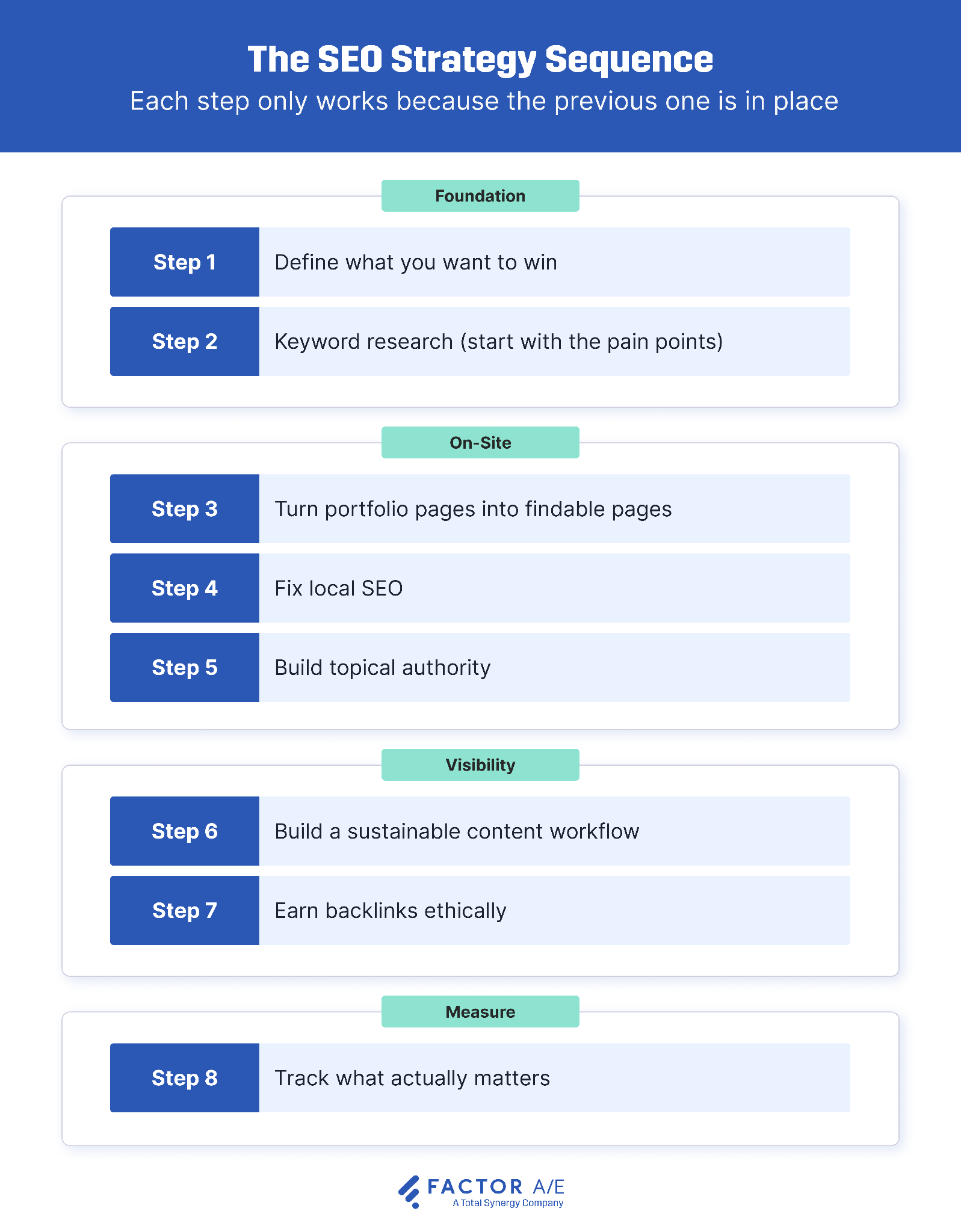
Step 1: Get specific about what your firm wants to win
Before doing keyword research, define your firm's focus as clearly as possible.
For example: “We design custom residential additions for homeowners in the Denver metro area.”
That sentence forces decisions firms avoid making directly. It defines the type of project, the type of client, and the geographic area the firm wants to be associated with.
Without that specificity, SEO tends to drift into broad messaging that is difficult for either search engines or potential clients to connect to a real need.
This is also the stage where firms need to look realistically at the search landscape. Search the phrases you want to appear for and look closely at who already ranks. In different markets, broad terms are dominated by larger firms with stronger websites, deeper content libraries, and years of accumulated authority.
That is why firms see better results by narrowing the target at first, focusing on a specific project type, client category, or local area where the competition is less established.
The firms that gain the fastest traction usually aren't trying to rank for everything at once. They first become strongly associated with something specific.
Step 2: Start keyword research with pain points, not volume
It’s tempting to start with the highest-search-volume terms first, but this often results in broad keywords that generate low-quality leads.
A better starting point is the kinds of searches people make when they already have a project in mind.
Search terms like “cost to hire an architect for a home addition,” “do I need an architect for a renovation permit in Austin,” or “architect for a hillside home in Denver,” reflect pain.
These searches are often more specific, less competitive, and closer to an actual inquiry. They also reflect how clients naturally describe projects, constraints, and decisions when seeking help.
From there, build your core service pages around combinations of service type and location. Keep the structure simple. One primary service focus per page, tied to one geographic area or market.
A lower-volume search with strong intent is often far more valuable than a broad term that attracts people who are only browsing.
Step 3: Turn portfolio pages into findable pages
This is where architecture sites break down. They have strong project pages but almost no written context.
A page title that says "Residence, 2023" instead of "Modern Hillside Residence in Boulder, Colorado" gives search engines nothing to work with.
Every important project page needs a written description that answers the basics: what kind of project is this, who it was for, where it happened, and what made it notable. Name every project image file descriptively, for example, "modern-hillside-home-boulder-colorado.jpg", not "IMG_4521.jpg", and write alt text that describes the project type, location, and key design detail.
Beyond that, credibility signals matter. Named principals with credentials, descriptions of the problem the project solved, and schema markup if your team can implement it. These help your site read as a real business with real expertise, not just a gallery.
Once those pages exist, link them properly. Blog posts should point back to the relevant service page, and new pages should not be left isolated.
Step 4: Fix local SEO before doing anything fancy
Local visibility often drives the first qualified inquiry, so before investing in complex SEO strategies, make sure the basics are handled well.
Start with your Google Business Profile. Claim it, fill it out completely, add recent project photos, and list specific services rather than broad categories.
Firms with complete, active profiles are significantly more likely to be visited and contacted than firms with thin or unclaimed listings.
Then clean up your listings everywhere else. Your firm's name, address, and phone number should match across every place you appear: AIA directories, Yelp, local business listings, and any industry-specific directories relevant to your market.
Search engines use this consistency to verify legitimacy and location authority. Even small inconsistencies can suppress local rankings.
Reviews matter too. Firms rarely ask for them, even though reviews are one of the strongest local trust signals available.
The best time to ask is usually near project close, when the outcome is still fresh, and the relationship is warm. Send a direct link. Make it easy. A short, specific review about the project experience is often more valuable than a generic five-star rating.
Step 5: Build topical authority around your niche
One service page is rarely enough to rank consistently. Search engines want to see depth, not just a single page targeting a keyword.
What tends to work better is a content cluster: one main service page supported by several narrower pieces that answer the questions buyers ask before they hire.
If your core page is “residential addition architect Denver,” your supporting content might include topics like how much a home addition costs in Denver, whether permits are required, whether to hire an architect or a contractor for a remodel, and what to expect from a hillside addition project.
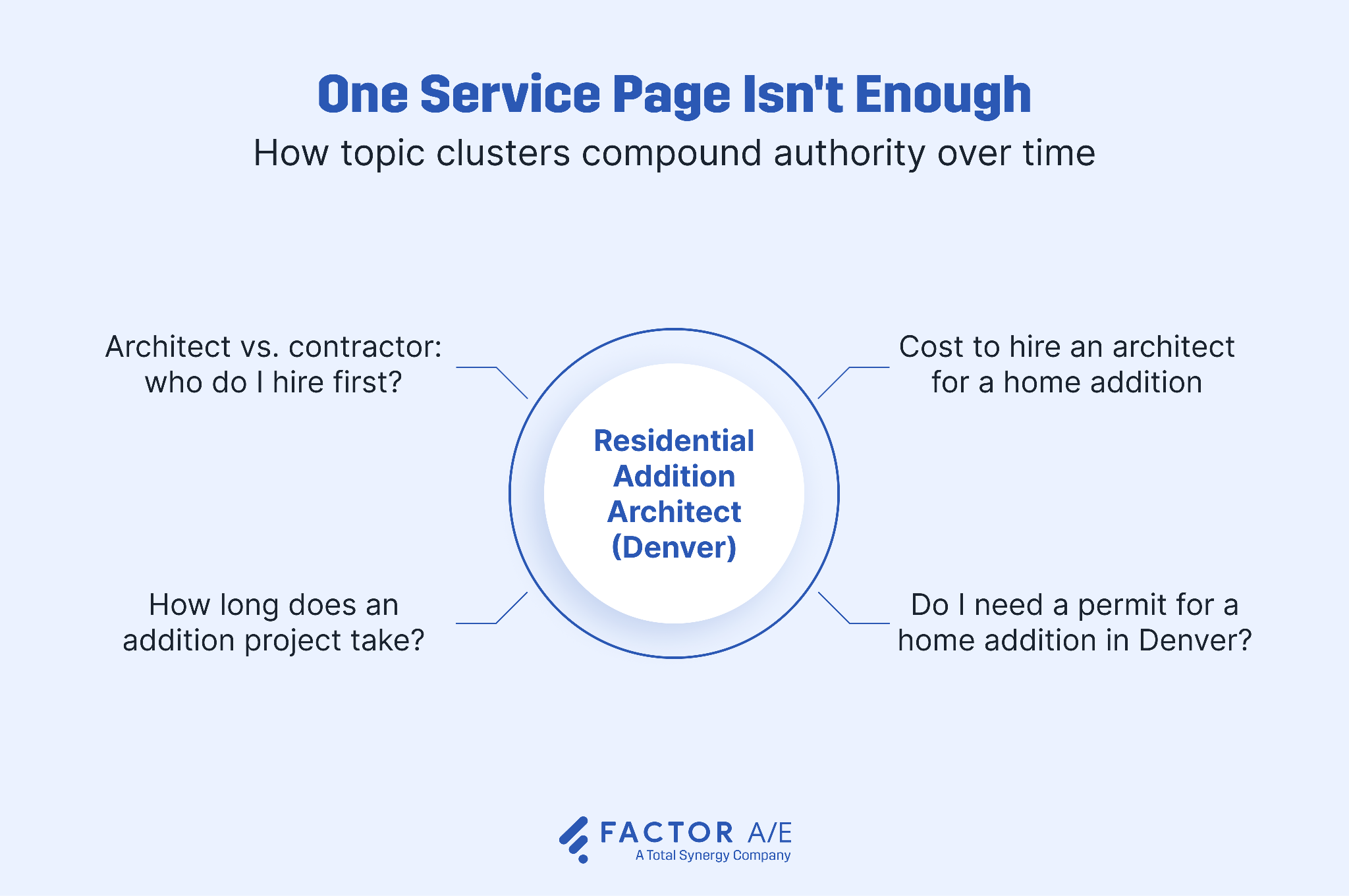
This approach works because it mirrors how potential clients search. They rarely start by looking for a firm immediately. First, they research costs, timelines, constraints, risks, and processes. Firms that answer those questions early earn trust earlier.
That is how authority begins to build through several focused pieces, each answering a question at every stage of the decision-making process.
Each piece should link back to the main service page and, where relevant, to related articles within the cluster. Together, they create the kind of topical depth and internal structure that generic portfolio sites usually lack.
Over time, this compounds. A well-built content cluster helps search engines understand what your firm specializes in and gives prospective clients multiple entry points into your site.
Step 6: Build a content workflow your firm can sustain
Usually, the principal or someone already stretched thin is trying to squeeze content-creation efforts into the time available for actual project responsibilities.
So the content plan has to fit that reality. Consistency matters more than volume. Three strong pieces a month are enough to make meaningful progress if they support the right service structure and target the right questions. Six pieces a month will move faster, but only if the process is realistic enough to sustain.
A few operating rules help. Update existing pages before creating new ones. Batch topics and outlines quarterly, so content planning does not become a weekly distraction.
Keep the editorial calendar simple by publishing what prospective clients actually ask about, not just what sounds good for SEO.
This matters because sustainable publishing tends to outperform short bursts of activity followed by long gaps. Search visibility compounds over time, especially when content stays aligned with the firm's core services and expertise.
And once something is published, do not just leave it there. Share it on LinkedIn, both from the firm page and the principal's personal profile. Send it to your email list. Pass it along to partners, consultants, or collaborators mentioned in the piece. A good page with no distribution usually gains little traction.
Step 7: Earn backlinks ethically
For A&E firms, the strongest backlinks usually come from places that already overlap with the firm's work and reputation: regional design publications, AIA chapter directories, ArchDaily, local press, contractor websites, and collaborators who feature completed projects.
These mentions help search engines understand that the firm is recognized by other credible sources in the industry, and they increasingly influence visibility in AI-generated answers too.
A published project, directory listing, or industry feature does more than drive referral traffic. It adds another signal tying the firm to a specific type of work, expertise, or location.
Step 8: Track relevant metrics
A firm can get more organic visits and still see no meaningful business result if the wrong people are landing on the site. Google Search Console is the right starting tool: free, native, and precise about which searches are surfacing your site and which pages are gaining ground. Review it monthly.
Read the early signals correctly. A page moving from position 40 to position 18 is the strategy working, not stalling. According to Ahrefs, most new pages take six to twelve months to earn reliable traffic, and longer in competitive markets. Set that expectation before you start, not after you stall.
The 90-day failure pattern is common: firms make a few changes, publish a couple of pages, wait a month, and conclude SEO does not work. That is almost always too early. Three to six months is when early movement appears. Twelve months is when a reliable flow of inquiry tends to establish itself.
Beyond traditional search: monitor whether your firm is surfacing in AI-generated answers for your target terms. When someone asks ChatGPT or Perplexity for an architect in your market, is your firm in the response?
AI tools reward what has already been published, cited, and structured. The same foundation feeds both Google and AI surfaces.
Cadence: review monthly, adjust quarterly.
Should You Handle SEO In-House or Hire Help?
The answer depends less on preference than on constraint. Three questions determine it:
- Does someone at the firm have three to five hours a month to consistently own this?
- Does that person understand the firm's project types and positioning well enough to write about them credibly?
- Is leadership committed to a twelve-month runway before expecting reliable results?
If yes to all three, doing it in-house is viable. The content will be more specific, more credible, and better connected to how the firm actually wins work.
If the answer to any of those is no, whether because of bandwidth constraints, a previous attempt that stalled, or a genuinely competitive target market, outside help is worth the investment. Look for an agency with B2B SEO experience, not just general local SEO.
The right person needs to understand how A&E firms win work, not just how to write a meta description.
For some firms, a hybrid model often makes the most sense: in-house ownership of content and positioning, with external support for technical SEO and backlink building.
That division keeps the firm's voice and project knowledge in the content while offloading the parts that require specialized tools and time.
SEO is How the Right Clients Find You First
The architecture firms that perform best in search are usually not the firms trying to describe themselves broadly. They are the firms that clearly communicate the kinds of projects they take on, the clients they work with, and the places where they work.
That clarity affects more than rankings. It shapes the kinds of inquiries coming in, the projects the firm becomes known for, and how consistently the pipeline aligns with the work the team actually wants to do.
The firms that get found first are usually the firms that already know exactly what they want to be found for.
If your firm is trying to become more intentional about the types of projects it pursues and how work moves through the business, Factor AE’s Process Mapper can help visualize the operational side of that workflow, from project delivery to staffing and financial visibility.

Recommended articles

.png)

See Factor in action
In one quick call, we’ll show you a simpler way to run projects and get paid faster.
.png)
“I recommend Factor to other firms. The team is great, it’s easy to use, and it has streamlined my project management. It can do the same for yours.”
Adam Mayberry
Architect / Managing Principal


